
Allergic rhinitis and common cold can look identical because both start with sneezing and a stuffy or runny nose.
But while a viral cold usually settles within a week, nasal allergy often keeps coming back with dust, AC, weather change or after cleaning the house.
Understanding this difference early prevents repeated antibiotics, overuse of nasal drops and persistent sleep disturbance.
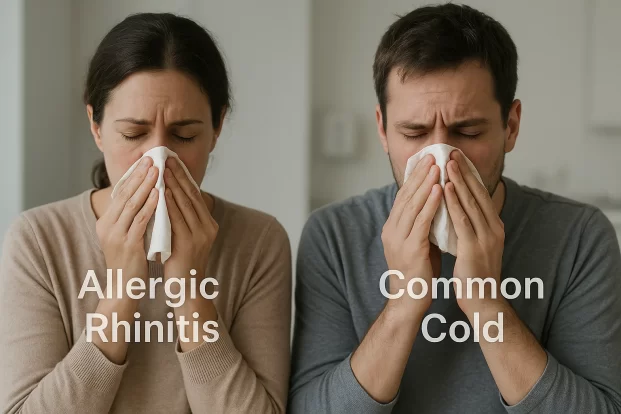
Cold and nasal allergy affect the lining of the nose and cause swelling, congestion and increased mucus production. This is why the first few days often look identical.
Sneezing, blocked nose and watery discharge do not immediately reveal whether the cause is a viral infection or an allergic response.
The difference becomes clearer only by observing how long symptoms last and what triggers.
A common cold is a short-lasting viral infection of the nose and throat.
It usually starts suddenly after contact with a sick person, after a change in weather, travel or when immunity is low.
In most people, a common cold improves within 5–7 days and rarely lasts beyond 10–14 days.
If a “cold” seems to drag on every time, or symptoms are present on most days, it is less likely to be just a simple viral cold and more likely to have an allergic or sinus component.
You can read more about frequent cold/nose block .
Allergic rhinitis is a nose sensitivity that keeps returning with certain patient specific allergy triggers often dust, pollen, AC air or weather change.
The lining inside the nose becomes swollen and produces clear mucus, which leads to sneezing, blocked nose or itching.
Unlike a cold that improves on its own within days, these symptoms tend to repeat in a familiar pattern- early morning, after cleaning, during whether change or with AC and do not fully settle between episode.
You can read more about allergic rhinitis treatment.
Repeated congestion, sneezing, watery discharge with dust, AC air, or closed rooms points more toward allergic rhinitis than a viral cold.
In contrast, infection-related colds tend to settle on their own within a week and often include fever, body ache or thicker mucus during the course.
When itching is noticeable inside the nose, allergy is more likely. When they are brief, and do not return with the same triggers, cold is more likely
| Feature | Allergic Rhinitis | Common Cold |
|---|---|---|
| Cause | Allergy triggers (dust, pollen, AC, pets) | Viral infection |
| Onset | Immediate with exposure | Gradual, 1–3 days after contact |
| Sneezing | Frequent, in bouts | Mild to moderate |
| Nasal discharge | Clear, watery | May turn thick or yellow/green |
| Itching (nose/eyes) | Common | Rare |
| Fever / body ache | Rare | May be present |
| Duration | Weeks or months | Usually 5–7 days |
| Pattern | Repeats with same triggers | One-time illness, settles daily |
Some patients have an underlying allergic rhinitis and then get a viral cold over it.
In such cases, the viral infection recovers, but the allergic swelling in the nose remains and so sneezing and congestion do not fully settle.
This overlap is common and often explains why repeated courses of cold medicines do not give lasting relief.
Diagnosis of cold and allergic rhinitis starts with symptoms duration and pattern.
ENT doctor will ask when the nose is blocked, when sneezing is worst, and whether symptoms disappear fully between episodes.
If symptoms clear in a week, infection is likely. If they return in familiar situations or never fully resolve, allergy becomes a consideration.
On examination, ENT will assess the nasal lining, color of mucus, turbinate size and airflow. nasal endoscopy ma be used to see the passages directly.
Allergy testing is considered only when symptoms are persistent or triggers are unclear.
Viral cold usually needs only short-term treatment and care.
Fluids, rest, saline nasal wash and, when required, a few days of prescribed decongestants or pain relief are usually enough.
Symptoms ease on their own as the infection settles, without needing long-term medication.
In allergic rhinitis, the treatment focus is on calming the inflamed lining of the nose and reducing the exposure to triggers.
Regular use of nasal steroid sprays, saline rinses and anti-allergic tablets may be advised.
If congestion and sneezing keep returning over months, allergy testing and a long-term control plan are discussed.
The purpose is to prevent repeated episodes rather than treat each episode as a new cold.
Decongestant nasal drops should not be used for longer periods as these are habit forming and may worsen the nose blockage.
If nasal blockage continues despite treatment, understanding when surgery helps is important. read the blog – Nasal blockage: surgery vs no surgery
You should see an ENT if a “cold” seems to last more than 10–14 days, or if nose blockage and sneezing are present on most days of the month.
Repeated episodes that start with the same triggers, trouble sleeping due to blocked nose, snoring, mouth breathing, facial pressure or reduced sense of smell are also reasons to get evaluated.
In children, ongoing nasal voice, poor sleep or frequent absence from school because of “cold” should be assessed rather than managed repeatedly with home remedies or over-the-counter medicines.
Persistent nasal symptoms can feel like a repeated cold, but many times they point toward allergy.
Looking at the pattern, duration, and response to triggers helps separate the two.
A clear understanding of these differences prevents repeated medicines and guides the right treatment approach.
For long-standing nasal sensitivity and morning sneezing, consistent long term care works better than intermittent treatment only during flare ups.
If your nasal symptoms continue beyond expected duration or repeat, you can schedule an ENT evaluation at our Allergy & Sinus clinic in Navi Mumbai.
Related blogs:
If symptoms keep repeating with dust exposure, AC, or weather change, allergy is more likely. A cold usually improves within a week.
If sneezing keeps coming back with exposure to trigger exposure, every mornings or during weather change and doesn’t fully settle, it is more likely allergy.
If it comes with body ache or fever and improves within a week, it is more likely a cold.
No. A cold does not turn into an allergy. Repeated “colds” usually mean an underlying nasal allergy or sinus issue that was already present and gets mistaken for infection.
Temporary relief with cold medicines and symptoms coming back often suggests allergic rhinitis rather than an infection.

Hi, I’m Dr. Archana Jhawar, an ENT specialist with over 24 years of experience. I specialize in tinnitus treatment, vertigo , ear care, and ear surgeries, practicing at Neoalta Clinic, Vashi, and Kokilaben Dhirubhai Ambani Hospital in Navi Mumbai. I’ve trained in vertigo management and Rational Emotive Behavior Therapy (REBT), combining science with compassion to offer holistic, evidence-based care. I’m passionate about writing, poetry, music, yoga, and photography.
Home Sleep Study or Hospital Lab: Choosing the Right Test
Snoring, Gasping, or Fatigue: Is it Nasal Allergy or Sleep Apnea?
Nasal Allergy and Sleep Problems: Why You Feel Tired All Day
When Nasal Blockage Needs Surgery – And When It Doesn’t
Daily Allergy Triggers: Dust, AC, Pets, Pollen and What to Do