
Snoring, a blocked nose at night, mouth breathing, or waking up tired are problems many people live with for years. Most assume it is due to nasal allergy and keep managing it on and off.
But when sleep stays disturbed or daytime fatigue becomes constant, they may point to sleep apnea. Missing the difference between Nasal allergy vs sleep apnea can delay proper treatment.
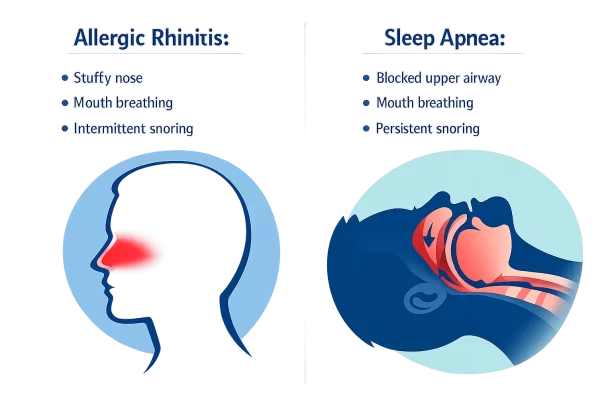
Many symptoms of nasal allergy and sleep apnea overlap and can cause snoring, mouth breathing, and disturbed sleep.
It is often not an “either-or” situation; nasal allergy can be a major contributing factor to Sleep Apnea. Because the upper airway is a continuous tube, a blockage at the “top” (the nose) increases negative pressure further down, making the throat more likely to collapse.
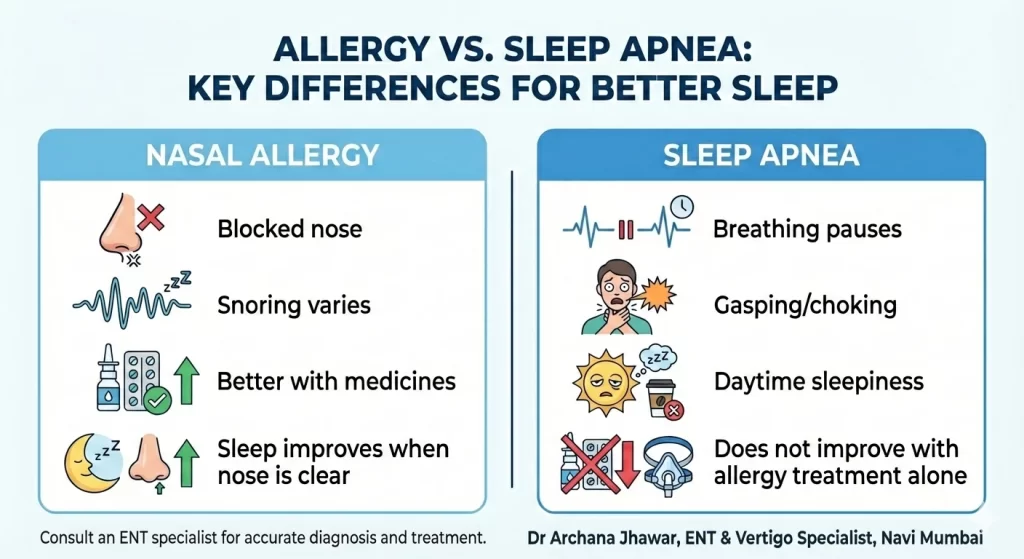
However, there are some patterns that may help tell them apart.
In allergy-related sleep disturbances, the problem usually starts with nasal blockage.
You may notice:
• Blocked or stuffy nose that changes from day to day
• Sneezing, itching, or watery nose
• Snoring that improves when allergy medicines work
• Better sleep on days when the nose feels clearer
Read blog about Nasal Allergy and Sleep Problems
Sleep apnea is related to upper airway collapse during sleep, not just nasal blockage.
Clues that point more towards sleep apnea include
In sleep apnea, symptoms usually persist and do not improve much with allergy treatment alone.
This difference is important because while nasal allergy is treated medically, sleep apnea needs proper ENT evaluation and management to prevent long-term health issues.
We naturally breathe through the nose. When you breathe through your mouth during sleep, it usually indicates a blockage in the upper airway – the nose, nasopharynx, throat or larynx.
Mouth breathing can lead to:
Persistent mouth breathing at night is often linked to structural nasal issues.
Read more about chronic nasal blockage and when septoplasty helps.
Gasping or choaking during sleep suggests that breathing is briefly stopping and we are not getting enough oxygen at that moment.
As a result, your brain is forcing you out of sleep to restart breathing. These repeated micro-awakenings prevent deep sleep, contribute to daytime brain fog, and strain the heart, and brain over time.
Unlike the “dull heaviness” of an allergy, a Sleep Apnea morning headache is a specific physiological response to poor breathing.
When your breathing stops or becomes shallow:
CO2 Buildup (Hypercapnia): As carbon dioxide levels rise, it causes vasodilation (widening of blood vessels) in the brain, leading to a throbbing morning headache.
Oxygen Drops (O2): Recurrent drops in oxygen levels during the night put significant strain on the brain and heart.
Fragmented Sleep & Increased Blood Pressures: Micro-awakenings, increased blood pressure, and teeth grinding (bruxism) further contribute to physical pain upon waking.
Note: These headaches are typically bilateral, felt immediately upon waking and improves within one hour as normal breathing restores oxygen balance. This is unlike “Sinus headaches” which may last all day.
Source PMC Study
If you experience this, it is a clear indicator that your airway is collapsing, and an ENT evaluation for Sleep Apnea is urgent.
A sleep study (polysomnography) is recommended when snoring is frequent and is accompanied by signs of disturbed breathing, poor-quality sleep, or daytime symptoms.
Some people with sleep apnea snore loudly, while others may snore softly or not much at all. The decision for a sleep study is therefore not based on snoring loudness.
Following are factors which may indicate the need for a sleep study:
Witnessed Apnea by bed partner: Pauses in breathing, choking, or gasping noticed during sleep
Day time impact: Excessive daytime sleepiness, poor focus, or morning headaches.
Systemic health Issues: High blood pressure, diabetes, weight gain, or heart-related issues..
Treatment failure: Snoring or disturbed sleep even after allergy treatment or septoplasty.
A sleep study helps confirm what is happening at night, whether there is sleep apnea and if oxygen levels are dropping. The results help guide the right treatment, instead of relying on guesswork.
Read more about home and lab sleep study in Vashi, Navi Mumbai
No, while allergy medicines and nasal sprays can clear the nasal passage, they cannot resolve the structural blockage or dynamic blockage (collapsed airway due to loss of muscle tone during sleep) seen in sleep apnea.
If you find yourself using nasal sprays daily but still waking up tired, it is a sign that the blockage is deeper than just the nose.
If symptoms point mainly towards nasal allergy, allergy management often improves sleep.
This may include medical treatment, allergy testing if required, and managing factors that worsen night-time congestion. You can also read the blog about daily allergy triggers.
If features suggest sleep apnea, a sleep study helps identify whether breathing is being interrupted during sleep and what form of treatment will be effective. Read upcoming blog home vs lab sleep study.
An ENT consultation is often the right first step for snoring or mouth breathing during sleep.
ENT specialists have equipment and expertise to examine the nose and throat.
This helps identify nasal allergy, or physical blockages (deviated septum, enlarged turbinates, nasal polyp, enlarged adenoids, tonsils, or throat-level narrowing that may be disturbing sleep.
He may also assess if DISE (Drug-Induced Sleep Endoscopy) is required.
This is an endoscopy of upper airway where we observe exactly where it collapses while you are in drug induced sleep-like state. This helps us take surgery decisions.
Care may involve sleep medicine or chest specialists as part of a comprehensive approach.
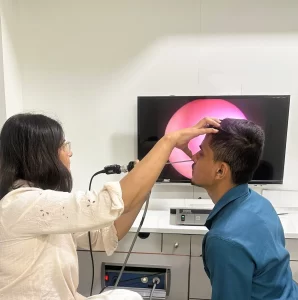 For patients in Navi Mumbai, an ENT assessment at Neoalta Speciality Clinic, sector 17, Vashi or Kokilaben Hospital, can clarify whether allergy, or sleep apnea is the root cause.
Dr Archana Jhawar is a senior ENT specialist in Navi Mumbai and expert in sinus, allergy and sleep evaluations.
Book consultation at our Allergy & Sinus clinic in Navi Mumbai.
Doctor’s Reply: We can tell this by the pattern and symptoms. If snoring varies with nasal blockage and running nose, sneezing and improves with allergy treatment, allergy is more likely.
If snoring is persistent and associated with choaking, breathing pauses, or ongoing daytime tiredness, sleep apnea is more likely.
A focused ENT evaluation is required to determine if the blockage is just allergy or there could be sleep apnea.
Doctor’s Reply: If symptoms include nasal blockage, mouth breathing, or allergy-related complaints, an ENT evaluation is often the right first step.
For patients in Navi Mumbai, an ENT checks for structural blockages in the nose and throat (like a deviated septum or enlarged tonsils).
If a sleep study confirms Sleep Apnea, we often work with chest specialists to coordinate long-term care like CPAP.
Doctor’s Reply: It depends. If your snoring is caused solely by nasal congestion, nasal sprays and treating the allergy can provide relief.
However, for many patients snoring is ‘multifactorial’, meaning upper airway blockage may be at multiple levels. You may still require specialized treatment like a CPAP or a minor corrective procedure.
Doctor’s Reply: Yes. While allergies cause fatigue, Sleep Apnea headaches are caused by low oxygen and a buildup of Carbon Dioxide (Co2) in the blood overnight.
These are typically throbbing headaches felt right when you wake up that usually subside once you start breathing properly during the day.

Hi, I’m Dr. Archana Jhawar, an ENT specialist with over 24 years of experience. I specialize in tinnitus treatment, vertigo , ear care, and ear surgeries, practicing at Neoalta Clinic, Vashi, and Kokilaben Dhirubhai Ambani Hospital in Navi Mumbai. I’ve trained in vertigo management and Rational Emotive Behavior Therapy (REBT), combining science with compassion to offer holistic, evidence-based care. I’m passionate about writing, poetry, music, yoga, and photography.
Home Sleep Study or Hospital Lab: Choosing the Right Test
Snoring, Gasping, or Fatigue: Is it Nasal Allergy or Sleep Apnea?
Nasal Allergy and Sleep Problems: Why You Feel Tired All Day
When Nasal Blockage Needs Surgery – And When It Doesn’t
Daily Allergy Triggers: Dust, AC, Pets, Pollen and What to Do