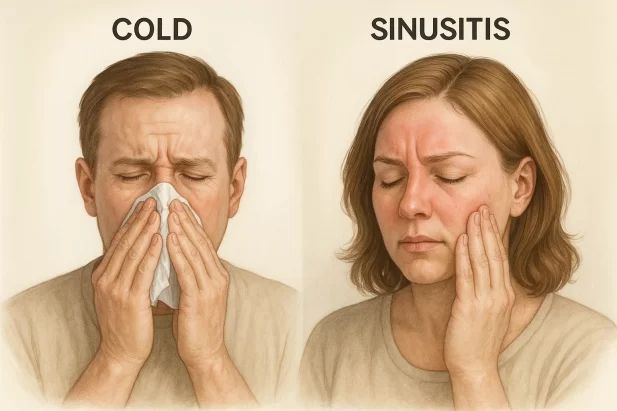
Sinusitis Symptoms Explained: When a Blocked Nose Is Not Just a Cold
Entdocnavimumbai
Allergy Care
A blocked nose that does not improve after a week often raises the question of whether it is still a cold or the start of sinusitis.
When this cold pattern continues instead of easing, it is often the first sign that the routine viral infection is leading to sinus involvement.
This blog explains common sinusitis symptoms and how they differ from a simple cold.
If you have a persistent blocked nose, understanding whether it is due to a cold or sinusitis can help you plan the next steps.
Table of contents
Why Sinusitis Is Often Mistaken For A Common Cold
The first few days of sinusitis and a viral cold can feel the same. The nose feels blocked, the face feels heavy and there is a general sense of tiredness.
With a cold these symptoms usually start to ease within a week. In sinusitis, congestion stays almost unchanged and facial pressure builds up over time.
Because the change is slow, people often continue to treat it as a cold even when the recovery pattern no longer fits.
What Sinusitis Is And How It Presents
In sinusitis, the lining inside the sinuses becomes swollen and the small drainage openings get blocked.
When this happens, mucus collects inside instead of clearing, air movement through the sinuses reduces and pressure builds in the cheeks, forehead or around the eyes.
The nose stays congested for longer than expected, despite cold medicines, and the sense of smell may reduce.
Some people notice thicker mucus or a taste of mucus at the back of the throat.
These symptoms tend to persist, which is why they suggest sinus involvement and help guide sinusitis treatment.
How Sinusitis Differs From A Simple Cold
Sinusitis is different from a routine cold.
A cold is viral upper respiratory infection. it usually starts quickly with a runny or stuffy nose, sneezing, sore throat or mild cough, and most people begin to improve within a few days.
In sinusitis, the symptoms often linger beyond 10 days without clear improvement, and the mucus may become thicker or discolored.
Pain or pressure around the eyes, cheeks, nose or forehead, a reduced sense of smell, and drainage down the back of the throat are more typical of sinus related problems.
When Sinusitis Becomes Long-Standing
Sinusitis usually improves with medical treatment.
Ongoing congestion, facial pressure, or reduced smell without a without a real break suggests this is moving toward chronic sinusitis.
When symptoms do not show improvement and continue for several weeks, it often means there is an underlying reason preventing proper recovery.
At this stage the condition needs reassessment by an ENT specialist.
Details of why sinusitis becomes long-standing and how it is treated are discussed in our blog on chronic sinus infection and its treatment.
How An ENT Evaluates Persistent Sinus Symptoms / Blocked Nose
An ENT specialist will ask you about your symptoms and for how long you have them.
Then he will examine your nose and throat with a headlight and nasal speculum to see any congestion in the mucus lining and inside structures.
A nasal endoscopy is done to view the passages directly and look for deviated nasal septum, any bone (turbinate) enlargement, polyps, discharge or structural blockage / narrowing.
Imaging is not routinely needed for every cold or sinus infection. However, your ENT may ask for a CT scan of the sinuses to map anatomy and extent of sinus involvement.
Typical reasons to ask for CT are- failure to improve after appropriate treatment, repeated flare-ups, unclear findings on endoscopy, suspicion of polyps or structural blockage, or when sinus surgery is being considered.
Allergy testing, sputum or nasal cultures and assessment for contributing factors (reflux, dental infection, smoking, medication use) are ordered as needed.
The goal is to identify cause such as allergy, obstruction, infection or other, so treatment is targeted, not empirical.
Treatment Of Sinusitis Depending On Type & Duration
First step in sinusitis treatment is to identify if it is acute, recurrent, or chronic sinusitis.
Treatment of sinusitis depends on how long the problem has been present and what is keeping the sinuses blocked.
Short episodes (Acute Sinusitis) often settle with simple measures such as steam inhalation, saline rinses, steroid nasal sprays and oral medicines that reduce swelling in the nose.
When symptoms return frequently (Recurrent Sinusitis) or lasts for many weeks (Chronic Sinusitis), treatment is directed at what is causing it.
In chronic sinusitis aim is to improve airflow and cleaning of sinus.
Allergy may need ongoing control, and structural issues may need a procedure. Your ENT will plan treatment step by step.
If nasal blockage continues despite treatment, understanding when surgery helps is important.
It is good to see an ENT when you think you have sinus symptoms.
If the nose feels blocked on most days, if sleep or day to day activity is disturbed because of congestion, a specialist check is helpful.
People who need repeated treatment , or those who feel the symptoms return soon after improving, also benefit from a specialist check.
ENT can examine the nose, check how the sinuses are draining and explain what is causing the constant symptoms, so the treatment can be planned.
Summary
A cold improves in a few days, while sinusitis tends to stay fixed or return in a similar pattern.
When the nose remains blocked, the face feels heavy or the sense of smell drops without steady improvement, the problem is often more than a routine viral cold.
Recognising this change helps you avoid repeated home remedies and guides you toward the right treatment.
If your “cold” is not settling in the usual time or the same symptoms keep coming back, an ENT review can help confirm whether sinusitis is the cause.
If the nose blockage stays the same, if facial heaviness increases, mucus thickened or if smell reduces, it is suggestive that cold has progressed to sinusitis.
Not always. A CT scan is considered when symptoms last many weeks, or return often or when ENT suspects deeper disease. it is not needed for every cold episode.
About Me
Hi, I’m Dr. Archana Jhawar, an ENT specialist with over 24 years of experience. I specialize in tinnitus treatment, vertigo , ear care, and ear surgeries, practicing at Neoalta Clinic, Vashi, and Kokilaben Dhirubhai Ambani Hospital in Navi Mumbai. I’ve trained in vertigo management and Rational Emotive Behavior Therapy (REBT), combining science with compassion to offer holistic, evidence-based care. I’m passionate about writing, poetry, music, yoga, and photography.