When Do You Need an Allergy Test? Skin Prick vs Blood IgE
Entdocnavimumbai
Allergy Care
An allergy test is often advised when sneezing, blocked or runny nose, or repeated sinus symptoms continue despite treatment.
Many people are unsure whether allergy is truly the cause or whether testing will change anything. Knowing when an allergy test is actually needed and which test gives useful answers helps avoid unnecessary medicines and helps in long-term control.
Table of contents
When Symptoms Suggest Allergy Rather Than Infection
Many people live with nasal allergy for years because the symptoms are mild and are mistaken for repeated colds.
Over time, people get used to repeated sneezing or a blocked or runny nose, and continue taking treatment without ever looking for the cause.
Symptoms are more likely due to allergy when they repeat with the same triggers, rather than behaving like a short viral cold.
Sneezing in bouts, clear nasal discharge, itching in the nose or eyes, and symptoms that worsen with dust exposure, weather change, air conditioning, or early morning are typical allergy clues.
The absence of fever and the tendency for symptoms to linger or recur over months also point away from infection.
When relief is partial and temporary with usual medicines, allergy becomes a stronger possibility than a simple cold.
To understand the difference more clearly, you can read our detailed blog on allergy vs common cold.
When Do You Actually Need An Allergy Test
Allergy Testing is considered when the symptom pattern strongly suggests allergy and the test result will change management.
It is useful when nasal blockage, sneezing, or sinus symptoms last for weeks, recur through the year, or clearly worsen with specific triggers like dust, weather change, or indoor exposure.
Testing is also helpful when medicines give only short-term relief, or when it is important to identify exact triggers before planning long-term treatment (for example starting immunotherapy)
In some situations, testing may not be required at all- especially when symptoms are mild, short-lived, or respond well to simple treatment, or when identifying triggers will not change management.
The decision is based on whether the result will meaningfully guide care, not on testing for its own sake.
What An Allergy Test Helps Identify
An allergy test helps your ENT identifywhat is causing your allergy symptoms.
It can point to specific triggers such as dust mites, pollen, mold or animal dander
This clarity helps explain why symptoms repeat despite treatment and why certain environments make them worse.
Allergy test results help your ENT decide the next step for your allergy management.
This could be simple avoidance of the substance causing allergy (trigger), or considering long term allergy treatment such as immunotherapy.
Allergy test results are always interpreted along with symptoms and examination. A test alone does not diagnose allergy.
Skin Prick Test vs Blood IgE Test
Skin prick test and blood IgE tests both work differently. The choice of test depends on the clinical situation.
Skin prick testing shows how skin reacts to allergen. and it gives immediate result.
It is often preferred when the skin is healthy and antihistamines can be stopped safely.
A blood IgE test measures allergy-related antibodies in the blood and is used when skin testing is not suitable, such as in people with active skin conditions (widespread eczema, recent severe reaction), or when antihistamine medicines cannot be paused.
The choice is guided by safety, practicality, and how clearly the result will answer the clinical question.
The two common allergy tests differ in how they are done and when each is useful.
Skin Prick Test vs Blood (IgE) Test for Allergy
Feature
Skin Prick Test
Blood (IgE) Test
How it is done
Tiny drops of allergens placed on skin with light pricks
Blood sample tested in a lab
Where it is done
Clinic or hospital
Lab collection centre
Time for results
15–20 minutes
1–3 days
Measures
Immediate allergic skin reaction
IgE antibody levels in blood
Accuracy for nasal allergy
Very good when properly done
Good, but slightly less sensitive
Affected by medicines
Yes (antihistamines must be stopped)
No effect from antihistamines
Suitable for children
Yes (with proper supervision)
Yes
Useful when
Need quick, clear trigger identification
Skin test not possible or medicines cannot be stopped
When To See An ENT For Allergy-Related Symptoms
You should see an ENT when nasal or sinus symptoms keep returning, disturb sleep or daily routine, or do not stay controlled with routine medicines.
An evaluation is also useful when symptoms follow a clear pattern, when the cause remains uncertain, or when long-term planning is needed rather than repeated short courses of treatment.
An ENT assessment helps decide whether allergy is the main driver, whether testing will add value, and what the next step should be.
Note: Some tests marketed online as “allergy tests” are not medically validated and can lead to incorrect diagnosis and unnecessary restrictions.
Reliable allergy testing should always be guided by a trained doctor.
Summary
Persistent nasal or sinus symptoms are often managed as repeated infections, but allergy is a frequent underlying cause.
Recognising symptom patterns helps decide when allergy testing adds value, rather than continuing trial-and-error treatment.
Identifying specific triggers through appropriate testing allows more focused, long-term control instead of repeated short-term relief.
If your nasal or sinus symptoms keep returning and you are unsure whether allergy testing is needed, an ENT evaluation can help clarify the cause and guide the next step.
You can book a consultation at my clinic in Navi Mumbai.
No, allergy test results are always interpreted along with your symptoms and examination by an ENT.
Positive allergy test helps confirm what is causing allergy but does not replace a proper evaluation by an ENT Specialist.
About Me
Hi, I’m Dr. Archana Jhawar, an ENT specialist with over 24 years of experience. I specialize in tinnitus treatment, vertigo , ear care, and ear surgeries, practicing at Neoalta Clinic, Vashi, and Kokilaben Dhirubhai Ambani Hospital in Navi Mumbai. I’ve trained in vertigo management and Rational Emotive Behavior Therapy (REBT), combining science with compassion to offer holistic, evidence-based care. I’m passionate about writing, poetry, music, yoga, and photography.


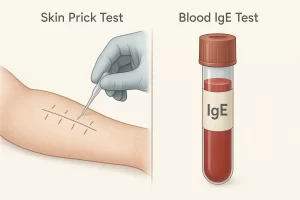 Skin prick testing shows how skin reacts to allergen. and it gives immediate result.