How to Read an Audiogram: Understanding Your Hearing Test Results
Entdocnavimumbai
Ear Care
If you’ve recently had a hearing test, you may be wondering what all it means.
Reading the audiogram chart can feel confusing at first, with all the symbols, lines, and numbers.
In this blog, I will explain how to read an audiogram, what the different symbol and line means, the different types and degrees of hearing loss, and the treatment options your ENT specialist may recommend after the hearing test.
A pure tone (PT) Audiogram graph shows type and degree of hearing loss – whether it is mild, moderate, severe or profound.
There are two axes in the graph.
The X-axis (Horizontal) represents different sound frequencies (pitch), ranging from the lowest 250 Hertz (Hz) to the highest 8000 Hz.
Most of the sound and speech we hear fall within this frequency range.
The Y-axis (Vertical) shows the loudness or intensity, measured in decibels (dB). It ranges from the -10 dB at the top to the highest 120 dB at the bottom.
Here -10 dB is the softest sound a person can hear and 120 dB is very loud sound.
Your results are plotted as a chart using red color for the right ear and blue for left ear.
Audiogram Symbols Explained
There are different symbols used to plot audiogram.
Air Conduction Symbols (AC)
Ac is when headphone is placed on the ear. The sound passes through all three parts of the ear (external ear, middle ear and then inner ear), before reaching the cochlea.
Right ear air conduction or AC is marked as red color circle “o” or triangle “△” and Blue “X” or square “▢“is left ear air conduction.
Bone Conduction Symbols (BC)
BC is when a probe is placed behind the ear on mastoid bone. It transmits the sound vibrations directly to inner ear (cochlea and hearing nerve).
BC is marked as angle or square brackets, open end indicates the ear tested, like [ or < for right ear and > or ] for the left ear.
Masked AC and BC Symbols
Masking in audiometry means the constant broad band noise is presented to non-test ear.
Masking non-test ear prevents cross-hearing, so that response marked are heard from only the ear being tested.
Masked air conduction is red triangle △ for right ear, and blue square▢ for left ear.
Masked bone conduction is red square bracket open toward right [ for right ear and blue square bracket opening towards left ] for left ear.
For now, remember: red = right, blue = left, this is enough to read an audiogram.
Your audiologist will explain any detailed symbols if needed.
Table: Different Symbols Used in Audiogram
Air Conduction
Bone Conduction
ORight ear unmasked
<Right ear unmasked
△Right ear masked
[Right ear masked
XLeft ear unmasked
>Left ear unmasked
▢Left ear masked
]Left ear masked
Once the hearing test is complete, your audiologist will plot the results on this graph. After understanding what each symbol and lines means, the next step is to interpret what the pattern reveals about your hearing.
Interpretation of Audiogram (How to Read an Audiogram)
Your audiologist or ENT specialist will explain your audiometry results in simple terms.
Here’s how to understand what your hearing test or audiogramshows- whether your hearing is normal, or if there is any hearing loss, and if so, what the degree (how much) and type (which part of the ear is affected) of hearing loss is.
Understanding the Type of Hearing Loss
Type of hearing loss or simply, what kind of hearing loss a person has, is identified by comparing the air conduction and bone conduction lines on the audiogram.
Conductive Hearing Loss
Conductive hearing loss is when only air conduction line dips down, and bone conduction line remains in normal range. So, there’s a visible gap between air and bone lines.
It usually suggests a problem in the outer or middle ear. This type is often treatable through medicines or minor procedures once the cause is known.
Sensorineural Hearing Loss (SNHL)
When both air and bone conduction lines fall below 20 dB, it points to a cochlear or nerve-related loss (sensorineural hearing loss).
The audiogram curve may be sloping or flat. Hearing aids or noise protection may help.
Mixed Hearing Loss
When both air and bone conduction lines dips down, but there’s still a gap between them, it indicates a combination of conductive and sensorineural loss.
In such cases, both the outer/middle ear and the inner ear or nerve may be involved.
Treatment usually includes addressing the middle ear condition and later fitting a suitable hearing aid if required.
Understanding the Degree of Hearing Loss
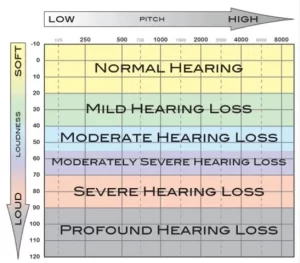
The degree or severity of hearing loss is determined by the position of the line on the Y-axis of the audiogram.
Audiologists calculate this from the average of three key frequencies – 500 Hz, 1 kHz, and 2 kHz.
The result is expressed in decibels of hearing level (dB HL) not as a percentage, though many people often confuse it as percentage hearing loss.
Here is what does normal hearing and levels of hearing loss on an audiogram means-
Normal Hearing on an audiogram means there is a straight line between -10 and 20 dB at all frequencies on an audiogram.
If the line dips down below 20 dB on this vertical axis, it means there is some level of hearing loss.
Mild Hearing Loss (20–40 dB) means soft sounds or distant voices may be missed. Family members may notice this before the person does.
Moderate Hearing Loss (41–65 dB) makes conversations unclear unless the volume is raised. The person may increase TV or phone volume.
Severe Hearing Loss (66–95 dB) means person can hear only loud voices close to ear. Hearing aids are usually required.
Profound Hearing Loss (over 95 dB) may make even loud environmental sounds difficult to hear.
The table below shows how hearing loss is classified and what each hearing loss level generally means-
Category
dB Range
Meaning & Next Step
Normal Hearing
Up to 20 dB
Everyday sounds are clear. Routine ear check-ups are enough.
Mild Hearing Loss
21–40 dB
Soft speech or distant voices may be missed. Early ENT review helps prevent worsening.
Moderate Hearing Loss
41–65 dB
Conversations become unclear without louder volume. A hearing aid trial may help.
Severe Hearing Loss
66–95 dB
Only loud voices close to the ear are heard. Needs ENT evaluation for treatment options.
Profound Hearing Loss
Over 95 dB
Even loud sounds are unclear. May need cochlear implant or rehab plan.
Your audiologist and ENT specialist team will interpret your audiogram findings in light of your symptoms, explain your results and discuss suitable treatment options.
A Note from my ENT Practice
Reading your audiogram helps you understand your hearing better, but it’s equally important to discuss the results with your ENT or audiologist.
Early diagnosis can prevent further damage and improve hearing outcomes as well as can also uncover hidden hearing loss conditions.
I often see patients who struggle to understand speech or complain of hearing issues even when their ENT examination and audiogram look completely normal.
This hidden hearing loss could be auditory processing disorder (APD or CAPD) or difficulty hearing in noisy environments (extended high frequency hearing loss- EHF), It can easily go undiagnosed without specific tests.
I’ve explained hidden hearing lossin detail in this blog, how it is diagnosed and what early signs to look out for.
ENT doctor will try to find out the cause of conductive hearing loss and may treat cold, sinus issues, infection, fluid, or perform a simple procedure to drain fluid in the middle ear.
ENT specialists prescribe immediate steroids for sudden sensorineural hearing loss treatment. You may read the blog to know more about the treatment of sudden sensorineural loss.
You may not require anything for mild sensorineural hearing loss and your ENT specialist may suggest to repeat the audiometry after few months, around 6month usually.
For permanent sensorineural hearing loss or age-related hearing loss, hearing aid is advised after hearing test. Studies prove early fitting of hearing aids is beneficial to protect further hearing loss.
Hearing protection is also advised to provide further damage.
Mixed Hearing Loss Treatment
Both medical treatment and hearing aids may be needed. Treatment is based on the cause of hearing loss.
If it is caused by otosclerosis – a stapedectomy surgery or hearing aid may be recommended depending on the air-bone gap in the audiogram and patient’s choice.
An audiogram shows how well each ear hears different sound frequencies and helps your ENT specialist identify where the hearing issue lies, in the outer, middle, or inner ear.
Pattern and position of different symbols help diagnose type of hearing loss (whether it is conductive, sensorineural, mixed), and how severe it is.
Audiogram interpretation helps plan the best treatment of hearing loss, such as medicines, ear cleaning, ear surgery or hearing aids.
After the hearing test, your ENT may recommend treatment depending upon the cause and severity.
Early interpretation and action protect your hearing and improve communication in daily life.
If your audiogram shows even mild or moderate hearing loss, don’t wait for it to progress.
A pure tone audiogram is a simple hearing test that checks your hearing. It helps your ENT or audiologist understand if your hearing is normal or if there’s any hearing loss.
You’ll wear headphones and listen to soft beeps at various volumes. The results are shown as a graph called an audiogram.
It shows how well you hear at different pitches and volumes, severity of your hearing loss if any, and whether your hearing issue is in the middle ear known as conductive hearing loss, or inner ear (cochlea and hearing nerves, a sensorineural hearing loss).
If the line on your audiogram stays between –10 and 20 dB, your hearing is normal. When the line dips below 20 dB, it means there’s some hearing loss. How deep the dip goes tells us whether it’s mild, moderate, or severe. Your ENT or audiologist will help you understand what this means in daily life, like whether you might miss soft sounds or find conversations unclear.
Once your hearing test is done, your audiologist and ENT will explain what the results mean for you. If everything looks normal, just follow good ear care and protect your hearing from loud noise. If there’s any hearing loss, your ENT doctor will guide you about the cause and next step, whether you need medicines, a hearing aid trial, or a follow-up test. Early action always gives better hearing outcomes.
About Me
Hi, I’m Dr. Archana Jhawar, an ENT specialist with over 24 years of experience. I specialize in tinnitus treatment, vertigo , ear care, and ear surgeries, practicing at Neoalta Clinic, Vashi, and Kokilaben Dhirubhai Ambani Hospital in Navi Mumbai. I’ve trained in vertigo management and Rational Emotive Behavior Therapy (REBT), combining science with compassion to offer holistic, evidence-based care. I’m passionate about writing, poetry, music, yoga, and photography.