
Certain ear surgeries can improve hearing when the underlying issue is structural and repairable. As an ENT surgeon in Navi Mumbai, I meet many people who come with this same question.
This blog explains ear surgeries that improve hearing, such as tympanoplasty, ossiculoplasty and stapes surgery, what each one repairs, and how they improve hearing.
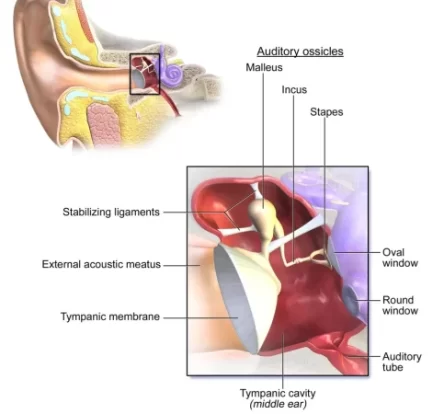
Image by By BruceBlaus / CC BY 3.0
When the ear’s structure is damaged, sound cannot travel the way it should. A hole in the eardrum, damaged ossicles, otosclerosis, or long-standing ear infection can block sound before it reaches the inner ear- this is called conductive hearing loss.
In these cases, ear surgery improves hearing by repairing the parts that carry sound.
Once these middle ear structures are intact, connected, and mobile, sound reaches the inner ear more clearly.
Temporary hearing loss from colds, wax, or fluid often improves with medicines. But when the middle-ear structure is damaged, surgical repair is what restores hearing.
If you’re unsure whether surgery is the right choice, read When to Choose Ear Surgery for Hearing Loss
These are the most frequently performed middle ear procedures to improve hearing. All these surgeries restore hearing by repairing the sound transmission pathway.
Tympanoplasty – repairs a perforated eardrum so sound vibrations travel normally again.
Ossiculoplasty – rebuilds or reconnects damaged middle-ear bones to restore the sound-conduction chain.
Stapes surgery (for otosclerosis) – replaces a fixed stapes with a tiny prosthesis so sound can enter the inner ear freely.
Cholesteatoma surgery with reconstruction – removes disease first, then hearing restoration procedure is performed.
Each operation corrects a different structural problem and the best procedure depends on the cause of hearing loss.
In the next sections, we’ll see how each one works and what kind of hearing improvement you can realistically expect.
Tympanoplasty closes a long-standing hole in the eardrum so sound can enter the ear correctly again. Sealing the perforation improves conductive hearing loss, helping everyday speech become clearer.
Expected improvement
Read about tympanoplasty (eardrum repair) at our clinic
Office Eardrum Patch Procedures
Sometimes, when there’s a tiny clean tear or pin point perforation in the tympanic membrane, a simple paper patch in the clinic can seal the hole.
Ossiculoplasty restores the tiny middle-ear bones when they have been damaged or disconnected, so sound can travel normally toward the inner ear and hearing can improve.
It repairs damage or loss of connection in the ossicular chain improving conductive hearing loss
Once the chain is rebuilt, sound can pass smoothly from the eardrum to the inner ear again, improving conductive hearing loss.
Expected improvement
Outcomes depend on how much disease had damaged the bones and how well the middle ear heals.
Stapes surgery treats hearing loss when the stapes bone becomes fixed due to otosclerosis and cannot transmit sound.
In this procedure, the immobile stapes is replaced with a tiny prosthesis (piston) so sound can enter the inner ear normally again.
Stapedectomy corrects Fixation of the stapes bone that blocks sound movement into the inner ear.
Once the prosthesis starts moving with the eardrum, sound reaches the inner ear more effectively. This surgery often gives noticeable hearing improvements among ear operations for conductive loss.
Meaningful hearing gain in most suitable patients
Best results when otosclerosis is limited to stapes fixation and the inner ear is healthy
Cholesteatoma surgery first aims to remove the disease safely, because long-standing infection and bone erosion can damage the middle ear.
Once the ear is clean and stable, hearing reconstruction is done either in the same surgery or later, depending on how much damage was present.
Hearing results depends on how much disease had damaged the ossicles, in some ears only partial or no hearing improvement is possible if disease were advanced.
Hearing restoration may need staged reconstruction.
Myringotomy with grommet insertion improves hearing when fluid behind the eardrum blocks sound and causes conductive hearing loss.
A small opening is made in the eardrum and a ventilation tube (grommet) is placed.
Clears middle ear fluid that was reducing sound transmission
Lets air enter the middle ear so the eardrum can move freely again
Hearing becomes clearer once middle ear ventilation is maintained
Best outcomes when underlying allergies or nasal issues are also managed.
Even when the middle ear has been repaired well, hearing may not return exactly as expected. Sometimes the ear surgery restores the pathway that carries the sound, but the inner ear itself struggles to process that sound.
When the nerve reserve or middle-ear condition limits clarity, improvement may be partial even if the surgery is fully successful.
If the inner ear (cochlea) and hearing nerve isn’t functioning at full strength, Ear surgery can fix the sound transmission pathway but it cannot restore it its ability to interpret sound.
Chronic ear infections, repeated discharge, cholesteatoma, or multiple previous ear surgeries can leave scarring around the ossicles and eardrum.
This stiffness reduces movement and sound transmission, so hearing may not return to normal even after reconstruction.
Hearing improvement after ear surgery are not always immediate. Some people notice clearer sound earlier, while others experience gradual changes as the ear heals and swelling reduces.
Brief phases of fullness or mild echo can happen while the middle ear adjusts. This is usually part of healing from ear surgery and not the sign of failed surgery
Your ENT surgeon will guide you on when to test hearing after ear surgery.
You can read in detail about hearing test after ear surgery and recovery after ear surgery.
Patients may need hearing aids even after ear surgery, when there is a sensorineural component or mixed hearing loss. Choosing a hearing aid after surgery doesn’t mean the surgery didn’t work.
When hearing loss is due to structural problems in the ear – like a perforated eardrum, damaged ossicles, otosclerosis, cholesteatoma, or middle-ear fluid, ear surgery can repair the issue and improve hearing.
The final result depends on both the condition of the middle ear and the inner ear (nerve) reserve, so improvement may be partial or near-normal.
The practical next step is a visit to an ENT specialist for ear examination and a detailed hearing test.
Based on the cause of hearing loss, your ENT can advise whether surgery, hearing aids, or a combination is the most suitable option in your case.
If you would like an opinion on whether ear surgery can improve your hearing, you can visit our ENT & Hearing clinic in Navi Mumbai.
You can also read more about Dr. Archana Jhawar, ENT specialist.
Results vary. Ear surgery can improve hearing when the problem is in the middle ear structure. Improvement varies based on middle-ear health and inner-ear (nerve) reserve.
So, some people regain near-normal hearing, while others experience significant improvement but still need hearing aids. Your ENT doctor will discuss realistic expectations
Tympanoplasty seals a hole in the eardrum, ossiculoplasty reconnects the hearing bones, and stapes surgery improves hearing by using piston. Each ear surgery improves hearing depending on which part of the ear is affected.
No. ear surgery improves hearing in conductive or mixed conductive hearing loss (caused by structural problems). but not on sensorineural hearing loss.
Conductive loss comes from a correctable pathway problem like a hole, or damaged hearing bones, so ear surgery can repair these and improve hearing.
Nerve-related loss comes from inner-ear damage, where surgery cannot help, and hearing aids or other type of rehabilitation surgery such as cochlear implant are may be advised .

Hi, I’m Dr. Archana Jhawar, an ENT specialist with over 24 years of experience. I specialize in tinnitus treatment, vertigo , ear care, and ear surgeries, practicing at Neoalta Clinic, Vashi, and Kokilaben Dhirubhai Ambani Hospital in Navi Mumbai. I’ve trained in vertigo management and Rational Emotive Behavior Therapy (REBT), combining science with compassion to offer holistic, evidence-based care. I’m passionate about writing, poetry, music, yoga, and photography.
Home Sleep Study or Hospital Lab: Choosing the Right Test
Snoring, Gasping, or Fatigue: Is it Nasal Allergy or Sleep Apnea?
Nasal Allergy and Sleep Problems: Why You Feel Tired All Day
When Nasal Blockage Needs Surgery – And When It Doesn’t
Daily Allergy Triggers: Dust, AC, Pets, Pollen and What to Do