
Some patients hear well after ear surgery, while others still feel speech is not clear enough. Many patients ask, “Do I need a hearing aid after ear surgery?” when hearing feels unclear in regular conversations.
This difference is expected because surgery repairs the middle-ear, but hearing also depends on the inner ear (nerve) function and after surgery healing.
This guide explains when surgery alone improves hearing, and when a hearing aid may still be advised based on audiogram results.
If you wish to understand candidacy further, you may refer to When to Choose Ear Surgery For hearing Loss.
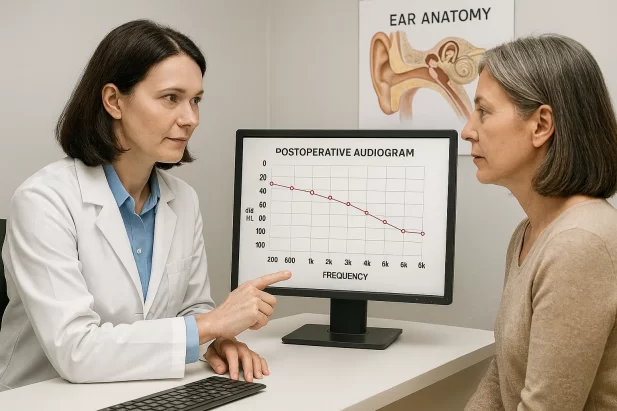
Hearing may not improve fully after ear surgery even when middle-ear pathway is restored successfully, because hearing clarity also depends on middle ear mobility, and inner-ear (cochlear and nerve) function.
If the middle ear movement is restricted or inner ear has limited reserve, words can still be unclear.
Main causes of reduced clarity even after ear surgery include:
Inner-ear or nerve related (sensorineural) hearing loss-like cochlear hair-cell loss from age and noise-exposure
Nerve pathway degeneration affecting speech discrimination
Long-standing middle-ear disease and adhesion before ear surgery
Post-surgical stiffness or scarring affecting sound movement
Eustachian tube dysfunction affecting middle-ear pressure.
Hearing becomes clear after ear surgery when the middle-ear problem is the only cause of hearing loss and the inner ear (nerve) function is intact.
In these situations, repairing the eardrum or ossicles restores the sound pathway without needing additional amplification.
Examples where surgery alone often provides clarity:
Tympanoplasty for eardrum perforation with healthy inner ear
Stapes surgery in otosclerosis when cochlear reserve is good
Ossiculoplasty when the ossicular chain is damaged but inner-ear function is normal
Myringotomy with Grommet insertion for SOM
When the mechanics of hearing are restored and the inner ear processes sound normally, patients typically experience improved clarity without requiring a hearing aid.
You can read about Ear Surgeries That Improve Hearing
A hearing aid may still be advised after ear surgery when the middle-ear repair is successful but inner-ear (cochlear or auditory nerve) reserve is limited, which surgery cannot restore.
In such cases, inner ear cannot process the sound efficiently.
Situations where a hearing aid remains necessary after ear surgery:
Here, the ear surgery addresses the mechanical sound transmission pathway, and the hearing aid supports signal processing and speech understanding.
Before surgery, the audiogram helps confirm whether repairing the middle ear is likely to improve hearing.
After ear surgery, the audiogram helps assess how much of the conductive hearing loss has improved and whether any inner-ear (nerve) limitation remains.
If the air–bone gap closes but speech clarity scores remain low, a hearing aid may still be advised.
For deeper understanding of interpreting post-operative improvements, see the hearing test after ear surgery blog.
If you need to understand pre-operative assessment flow, refer to the hearing test before surgery guide.
If you need a refresher on chart interpretation basics, you can review how to read an audiogram.
After ear surgery, a hearing aid does not “undo” nerve damage or make hearing completely normal. It mainly helps by making speech easier to hear and follow in daily life.
What the hearing aid helps with:
In these cases, hearing aids does not replace surgery, it supports after ear surgery whatever hearing capacity the inner ear still has.
When the middle-ear repair heals well and inner-ear function is preserved; ear surgery alone may provide clear hearing.
(see ear surgeries that improve hearing).
If the inner ear has reduced reserve, speech may remain unclear even with a successful outcome, and a hearing aid may still be recommended after ear surgery.
The next step is a follow-up ear examination and review of your post-surgery audiometry reports.
Based on these findings, your ENT specialist can guide whether hearing aid support is appropriate.
If you would like an opinion on whether you need hearing aid after ear surgery, you can visit our ENT & Hearing clinic in Navi Mumbai.
Because hearing depends on inner-ear (cochlear and nerve) function, not only the middle ear.
Surgery restores the middle ear, but if the inner ear has limited reserve, speech may remain difficult to follow.
A post-surgery audiogram results guide this decision.
If there is neural component, a hearing aid may be advised
No. Surgery can successfully repair the middle ear, and a hearing aid may still be required if the inner ear needs support for speech clarity, as surgery can not restore inner ear hearing function
A hearing aid is fitted only after the ear has healed after surgery and follow-up testing confirms stable hearing levels.

Hi, I’m Dr. Archana Jhawar, an ENT specialist with over 24 years of experience. I specialize in tinnitus treatment, vertigo , ear care, and ear surgeries, practicing at Neoalta Clinic, Vashi, and Kokilaben Dhirubhai Ambani Hospital in Navi Mumbai. I’ve trained in vertigo management and Rational Emotive Behavior Therapy (REBT), combining science with compassion to offer holistic, evidence-based care. I’m passionate about writing, poetry, music, yoga, and photography.
Home Sleep Study or Hospital Lab: Choosing the Right Test
Snoring, Gasping, or Fatigue: Is it Nasal Allergy or Sleep Apnea?
Nasal Allergy and Sleep Problems: Why You Feel Tired All Day
When Nasal Blockage Needs Surgery – And When It Doesn’t
Daily Allergy Triggers: Dust, AC, Pets, Pollen and What to Do