
A hearing test (audiogram) after ear surgery is a routine part of your follow-up care. It helps your ENT specialist see how your ear is healing and how sound is reaching the inner ear after the procedure.
Many patients feel unsure about what to expect after ear surgery and how their hearing will improve.
This blog explains what the post-operative audiogram checks, and what your report means for your recovery.
You can read the other blogs here about recovery after ear surgery and after care and What Is An Audiogram
The post-operative audiogram is needed to get a clear picture of how well the ear is functioning after the procedure.
It shows how the eardrum graft, middle-ear space, and sound conduction pathway are recovering.
Your ENT can compare your current hearing to the pre-op baseline hearing test results. He can see how much the air–bone gap, and sound thresholds have improved from your pre-operative results.
Audiogram results help decide if you only need routine follow-up or if fluid, pressure issues, or incomplete healing need attention.
Most patients need a follow-up hearing test a few weeks after surgery. The exact timing depends on the type of ear surgery performed.
The goal is to check hearing only after the swelling reduces, packing material dissolves, and the middle ear becomes stable enough for accurate results.
ENT will usually ask for post op audiogram 8-12 weeks after tympanoplasty, once eardrum graft settles and the ear canal is clear.
Earlier testing is avoided because packing, crusting, and middle ear swelling can temporarily reduce hearing.
Long term assessment can be done at 6–12 months.
A follow-up audiogram is generally done at 2–3 months, because the reconstructed ossicles and prosthesis need time to stabilize.
Small movements or early inflammation can affect hearing, so testing too early may not reflect final outcome.
Many studies report meaningful gains at 3–6 months and stabilization by 12 months following ossciculoplasty, so, another hearing test can be done at 6 month and 1 year.
Standard audiogram is performed at 6–12 weeks after stapes surgery. Early hearing check can be done at 3–4 weeks.
Hearing often improves quicky in stapes surgery, but the audiogram is still delayed a few weeks to allow the ear canal to heal and swelling to settle.
The first audiogram after mastoidectomy is usually done at 6–12 weeks.
Hearing recovery after mastoidectomy varies. In this surgery, the focus is more on safety and disease control than hearing improvement.
After ear surgery, hearing test is a simple, safe check of your middle ear hearing pathway. These post- surgery audiogram findings help your ENT understand how much improvement has happened.
Air Conduction (AC) shows how well sound passes through the ear canal, eardrum, and middle-ear bones.
After surgery, AC tells us:
Is the eardrum healing and moving well after surgery?
Are the middle-ear bones working properly?
Is there any fluid, swelling, or blockage during healing?
If AC improves compared to your pre-surgery test, it means eardrum and middle-ear bones are healing well and sound transmission is better than before, which is what we expect after most ear surgeries.
This checks the inner ear directly by bypassing the middle ear.
BC answers one main question:
Has the cochlea functioning remained stable after surgery?
Bone conduction usually stays the same before and after surgery. If it drops, we look for rare inner-ear problem.
This is one of the most important points after ear surgery.
A reduced AB gap is a good sign. It means that conductive hearing loss has improved.
A persistent AB gap means swelling, fluid, or ossicular issues that need follow-up.
We often compare the AB gap before and after surgery to check the success of the surgical repair, especially in middle ear procedures like, middle ear fluid, tympanoplasty, ossiculoplasty, and stapes surgeries.
These tests check how clearly the brain is recognizing speech after surgery.
Improvement shows the hearing pathway is settling well.
Poor clarity may point to nerve elements or temporary middle-ear issues.
Tympanometry is needed, helps your ENT see how the middle ear is functioning.
Healthy middle ear function is important for good outcome of ear surgery.
It gives us objective data on healing, especially after ventilation tube removal.
Easy rule: AC bettering + BC stable + ABG narrowing = surgical success.
If something is not matching the recovery pattern, your ENT can guide you on the next steps.
Your ENT uses these values to interpret the audiogram results. To learn more, you can read the blog – How to read your audiogram
These are common hearing related concerns after any ear surgery.
This is a very common concern in the post-operative period, especially in the first few weeks after ear surgery. Reasons include:
These usually improve over weeks. Persistent worsening or new severe symptoms should prompt review, but short-term muffling is expected.
These indicate that your hearing is improving during your hearing recovery after ear surgery
These signs often parallel the improvements seen on audiograms.
After the hearing test, your ear may feel a little different, ear may feel slightly “full” right after the test.
A few patients feel light dizziness for a moment, especially if the middle ear is still sensitive after surgery.
These all settles in a few minutes, nothing to worry about.
Many reasons can slow or limit hearing recovery after surgery and lead to a poor hearing outcome.
Next steps may include:
Medical treatment, gentle middle-ear exercises (if advised), follow-up audiograms, hearing-assist devices, second stage hearing restoration surgery, or rarely, revision surgery.
Importantly, choosing hearing aids does not mean the surgery failed, sometimes they are complementary tools for the best overall hearing outcome.
Your audiogram follow-up helps us understand the exact cause. Early review helps us treat complications and protect inner-ear function.
They reduce middle-ear swelling, which helps sound travel better and gives clearer results in your follow-up hearing tests.
Forceful nose blowing or strain can disturb graft or ossicles and affect your hearing test results.
Water slows healing and affects eardrum movement.
Loud noise may disturb threshold temporality or permanently. To see true recovery, it is good to avoid loud noise exposure.
Repeat audiogram after ear surgery shows how the operated ear is functioning and guide the next steps in your hearing recovery.
Your post-surgery hearing test gives a clear picture of how your ear is settling and whether sound is travelling more smoothly through the repaired middle ear.
It helps us confirm progress, reassure you about your hearing recovery, and guide you if anything needs attention.
After ear surgery, a short follow up visit and a repeat audiogram often clears up doubts about the success of ear surgery.
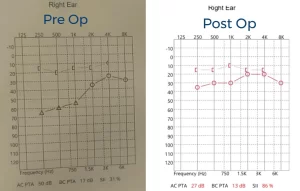
Hearing improvement can be seen in my patient Mrs K after mastoidectomy and tympanoplasty type III. Her post-operative audiogram at 10 weeks shows improved air-conduction thresholds and a reduced air-bone gap.
Related reading:
To learn about Tympanoplasty Surgery Types and Recovery Guide
Check study on Hearing Outcomes After Type III Tympanoplasty
First Hearing test is done usually after 8-12 weeks after ear surgery when swelling and ear packing have resolved
Blocked ear feeling after ear surgery is usually because of ear- packing, or tissue swelling, this usually improves with time.
It usually improves gradually over a few weeks. Clearer changes are seen around 6–12 weeks, and some surgeries continue improving for a few months.
It’s the difference between air and bone conduction thresholds. A smaller gap after surgery usually means better conductive hearing recovery.
yes. Your post-surgery hearing test shows how well sound is passing through the ear after the repair. If the softest sounds you can hear become better and the gap between air and bone lines becomes smaller, it usually means the ear surgery has successfully helped your hearing.

Hi, I’m Dr. Archana Jhawar, an ENT specialist with over 24 years of experience. I specialize in tinnitus treatment, vertigo , ear care, and ear surgeries, practicing at Neoalta Clinic, Vashi, and Kokilaben Dhirubhai Ambani Hospital in Navi Mumbai. I’ve trained in vertigo management and Rational Emotive Behavior Therapy (REBT), combining science with compassion to offer holistic, evidence-based care. I’m passionate about writing, poetry, music, yoga, and photography.
Home Sleep Study or Hospital Lab: Choosing the Right Test
Snoring, Gasping, or Fatigue: Is it Nasal Allergy or Sleep Apnea?
Nasal Allergy and Sleep Problems: Why You Feel Tired All Day
When Nasal Blockage Needs Surgery – And When It Doesn’t
Daily Allergy Triggers: Dust, AC, Pets, Pollen and What to Do