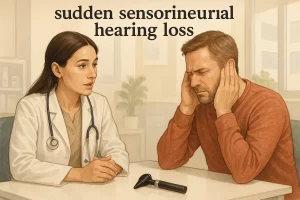
One morning you wake up and one ear feels heavy, muffled, as if cotton were stuffed inside. You try cleaning it, yawning, swallowing but the sound doesn’t return. Many people mistake this for simple ear blockage, but it could be sudden sensorineural hearing loss and it needs urgent treatment.
This blog is about sudden sensorineural hearing loss, what does it mean, what could be the cause and why visit an ENT doctor for treatment.
Table of contents
What Is Sudden Hearing Loss?
Sudden hearing loss, sudden sensorineural hearing loss or SSNHL is a rapid loss of hearing, usually in one ear, that develops within a few hours or up to three days.
Unlike earwax buildup or middle ear fluid, this condition affects the inner ear hearing receiver (cochlea) or nerve that carries sound to the brain. It can feel as though one ear has “shut down.”
Some people notice ringing sounds, mild dizziness, or a sense of fullness in the affected ear. These are early warning signsof sudden hearing loss that should never be ignored.
Doctors usually confirm the diagnosis through a simple hearing test(audiogram). With prompt ENT evaluation and treatment, many patients recover most or all of their hearing within weeks.
Common Causes of Sudden Hearing Loss
Most of the time, there is no evident reason of SSNHL (that’s means it is Idiopathic) but it is believed to be due to viral inflammation, blood supply issues, autoimmune disease or head trauma.
Sudden hearing loss can be due to Baro trauma – Pressure changes by diving or heavy weight lifting can cause perilymph fistula.
Certain ototoxic medications like Aspirin, diuretics and certain cancer chemotherapy medicines can affect hearing nerve and cause sensorineural hearing loss.
Rarely tumour of 8th nerve (acoustic neuroma) can cause rapid hearing loss.
Important point to mention here is that sensorineural hearing loss could be age related (Presbiacusis), or du to noise exposure over the years or after an ear infection but it develops gradually unlike sudden hearing loss.
How SSNHL Differs from Simple Ear Block?
Many patients confuse sudden hearing loss with a blocked ear because of wax, cold or ear infection.
These conditions may cause temporary hearing loss but reason is very different and so is the treatment.
Earwax, ear infection and fluid cause conductive hearing loss that means when sound cannot reach the inner ear.
These are visible when we examine the ear and give different type of tuning fork test results. This temporary hearing loss often improves quickly once the wax is removed or ear infection settles.
Sudden sensorineural hearing loss appears suddenly, often overnight or within hours, and does not improve by simply cleaning the ear.
Delaying treatment even for a few days can make the hearing loss permanent.
The key difference?
If your ear feels blocked suddenly but there’s no visible wax or ear infection, and you also notice ringing, imbalance, or a feeling that your own voice sounds echoey, visit an ENT doctor.
That may be a sign of sudden sensorineural hearing loss (SSNHL), which can become permanent hearing loss if not treated immediately.
Diagnosis and Tests for Sudden Hearing Loss
To diagnose SSNHL, we ENT doctors follow these steps:
Thorough assessment of onset of symptoms
We should ascertain that hearing loss is sudden and not a chronic one. Medical history of associated symptoms or condition is important to check for any probable cause.
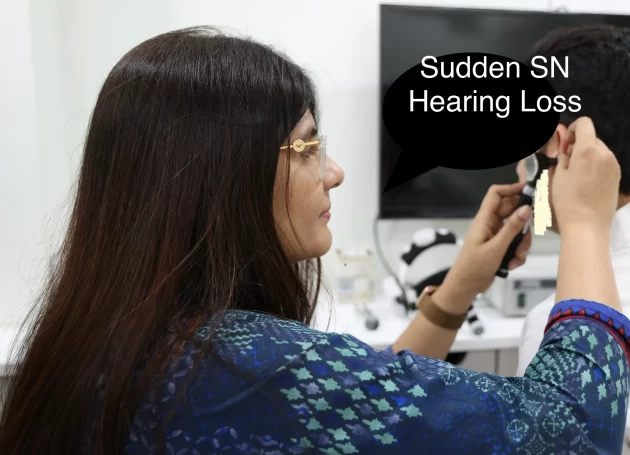
Ear check-up by video otoscope or endoscopy
Anything in the ear like wax, infection, pus, fluid and ear drum perforation is visible. If it is a clean ear and normal ear drum with no sign of blockage, it often means it could be an inner ear issue.
Tuning Fork test
TFT Result (with 256 Hz, 512 Hz and 1024 Hz tuning Fork) may tell us whether it is conductive or sensorineural hearing loss.
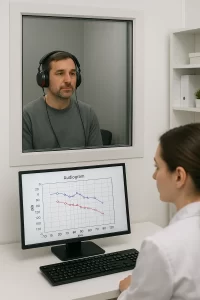
Hearing test (audiogram) and impedance Audiometry
Quick and painless hearing test (audiogram) measures how well you hear at different tones and volumes. It helps determine whether the loss is conductive (caused by outer or middle ear) or sensorineural (inner ear or nerve related).
Impedance audiometry may be advised if needed to check the middle ear.
MRI Scans
Gadolinium Enhanced MRI may be advised specially if it is one sided sudden hearing loss, to rule out nerve compression or rare 8th nerve tumor.
CT scan of temporal bones may be advised in cases of trauma.
Additional tests if needed
Your ENT may advise certain blood tests to identify viral, autoimmune, or vascular causes.
These tests help to understand what is the diagnosis, guide the best treatment for sudden hearing loss and help predict how much hearing can be regained.
Treatment for Sudden Sensorineural Hearing Loss (SSNHL)
The success off treatment of SSNHL depends on how quickly the patient visits an ENT specialist. The golden window is usually the first 24 to 72 hours after the hearing drops.
Medical Treatment of SSNHL
Corticosteroid – oral, injectable and intertympanic
Corticosteroids is the mainstay of treatment of sudden sensorineural hearing loss at present. It reduces inner ear inflammation and improves blood flow to the nerve of hearing.
Steroids can be given as tablets, injections or directly into the middle ear (intratympanic steroid injection for sudden sensorineural hearing loss)
Some ENT specialists find intratympanic steroid injections more effective while others believe that oral or IV steroids have same effect.
In many studies all three routes have been proven to have similar recovery rate, except profound hearing loss where intratympanic injection gives better results.
Antiviral or supportive medications
If viral infection is suspected to cause SSNHL, antiviral can be added.
Medicine to improve blood flow
These can be given sometimes to improve blood flow to inner ear and hearing nerves.
Treating underlying causes
If autoimmune or vascular factors are involved, your ENT may coordinate with other specialists for specific therapy. Viral infection may be treated with anti-viral medications.
Hearing aids or cochlear implant
If hearing loss does not improve completely a digital hearing aid may be advised. Sometimes for profound permanent hearing loss a cochlear implant is good choice.
Surgery
If perilymph fistula does not heal with bed rest then surgery is performed to repair it.
After a thorough history of symptoms and ear examination, I ask for an audiometry test.
I start with oral steroids and may advise for an MRI scan.
Follow up audiometry by our Audiologist is done to check the progress
After 2 weeks, intra tympanic steroid injection may be recommended
Can Sudden Hearing Loss be Reversed?
The outcome of SSNHL depends on time of starting treatment, age of the patient, presence of vertigo, and degree of hearing loss.
Studies confirms use of steroids for sudden hearing loss treatment can help in hearing restoration. Systemic and Intratympanic steroid injections are used by top ENTs.
Clinical studies report that 50% to 70% of patients with SSNHL regain their hearing even without treatment and sometimes hearing does not come back to normal even after appropriate treatment.
Most ENT doctors and hearing care experts find higher recovery rate with early start of treatment.
Most patients notice gradual improvement within a few days to 2 weeks. Hearing may return fully or partially. Regular follow up with ENT and serial Audiometry tests track the progress
If hearing does not recover completely hearing aids may be prescribed.
For persistent tinnitus, hearing aid, sound therapy, TRT or CBT may be required. Persistent dizziness is managed by VRT and CBT.
When to See an ENT?
When someone develops sudden drop in hearing, it’s a medical emergency.
Visiting an ENT specialist for sudden hearing loss within 24-48 hours makes all the difference. As timing is crucial for best results and hearing recovery, don’t wait for it to “open up on its own.”
If you ever notice a sudden change in hearing when you wake up or following a viral infection, visit Dr Archana Jhawar, ENT specialist Navi Mumbai. With 25 years of experience, she has advanced ENT & audiologist set -up for treatment of sudden hearing loss.
If your hearing drops suddenly, without pain, wax, or ear discharge and you feel ringing, fullness, or imbalance in that ear, it’s likely sensorineural hearing loss. Only an audiogram and ENT evaluation can confirm it
In most people, the cause isn’t clearly known, but possible triggers include viral infections, poor blood flow, autoimmune reactions, or inner ear inflammation.
Some patients recover partially, but the best recovery happens when treatment starts within 48–72 hours. Early use of steroids or other medical therapies gives the highest chance of regaining hearing. Delay in treatment can result in permanent hearing loss.
Oral steroids or intratympanic steroid injections are mainstay of treatment of sudden sensorineural hearing loss. The treatment is tailored after checking your audiogram, MRI (if done), and overall health
We may not be able to prevent SSNHL all the time especially idiopathic ones, but some tips can prevent hearing loss.
Avoiding loud noise, limiting the use of ear buds or head phones, and treating cold or ear infection early. Keep diabetes, cholesterol, and blood pressure under control and Schedule periodic hearing checks if you work in noisy surroundings or have had previous ear issues.
You can visit Dr Archana Jhawar, ENT specialist in Navi Mumbai, if hearing suddenly drops. She consults at her clinic in Vashi or at Kokilaben hospital Kopar-khairne, Navi Mumbai.
About Me
Hi, I’m Dr. Archana Jhawar, an ENT specialist with over 24 years of experience. I specialize in tinnitus treatment, vertigo , ear care, and ear surgeries, practicing at Neoalta Clinic, Vashi, and Kokilaben Dhirubhai Ambani Hospital in Navi Mumbai. I’ve trained in vertigo management and Rational Emotive Behavior Therapy (REBT), combining science with compassion to offer holistic, evidence-based care. I’m passionate about writing, poetry, music, yoga, and photography.

 TFT Result (with 256 Hz, 512 Hz and 1024 Hz tuning Fork) may tell us whether it is conductive or sensorineural hearing loss.