
Many patients come to me unsure about when ear surgery for hearing loss is actually needed. They often ask whether surgery can improve hearing.
Hearing loss can happen for many reasons. Some causes improve with medicines and some need hearing aids.
Ear surgery is considered only when the hearing loss is due to a repairable problem in the middle-ear, when medical treatment has not helped, and sometimes, when hearing aid doesn’t work.
This blog is a simple guide to help you understand when ear surgery for hearing loss makes sense and when other options are better.
ENT surgeon will advise hearing restoration surgery only when repairing the sound conduction pathway can meaningfully improve hearing. In these situations, medicines or hearing aids cannot correct the hearing problem because sound is not reaching the inner ear properly.
Common situations where surgery may help improve hearing:
When middle-ear fluid does not clear after medical treatment, it affects hearing and needs correction.
If the perforation has persisted for more than 3 months or keeps getting infected, surgical repair of ear drum becomes the next step.
This may happen when middle ear ossicles are damaged or fixed after ear infections, or disconnected after trauma. Ear surgery is also an option for hereditary stapes bone fixation (otosclerosis) with conductive hearing loss.
Medicines cannot correct these. Middle ear bone problems and require surgical correction.
Mastoid disease or cholesteatoma require ear surgery to clear infection, prevent complications and improve or stabilize hearing.
Profound SNHL where hearing aids are not helping and advanced solutions are needed
One important point to remember– ENT surgeons advise ear surgery to repair the hole in the ear drum or treat cholesteatoma even when there is no chance of hearing improvement.
Related Links
Read about the types of ear surgeries for hearing loss→ Ear surgeries that improve hearing
If you already have a confirmed diagnosis, read individual surgery details:
Am I a candidate for ear surgery?
Not every type of hearing loss needs surgery.
You may need to consider ear surgery if any of these apply to you:
These are practical signs that the problem may not improve with medicines alone and needs further middle ear correction.
Before advising surgery, your ENT will check a few key things to confirm that the hearing loss is due to a correctable middle-ear problem and whether ear surgery has a reasonable chance of improving hearing.
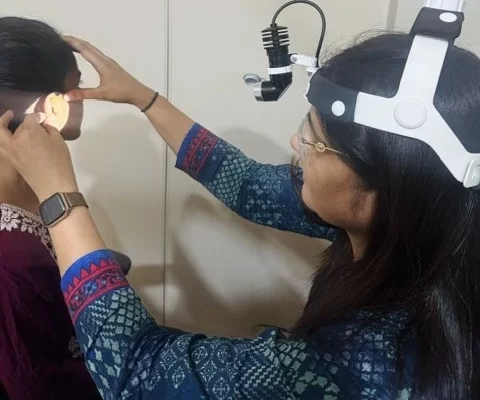
ENT specialist will check condition of the eardrum, presence of fluid, ear infection, or cholesteatoma using video otoscopy. He will take a thorough history of symptoms and past treatments.
A conductive hearing loss pattern with a clear air–bone gap in audiogram often indicates a surgically correctable problem. Tympanometry and middle ear function test to check middle ear function.
If the inner ear (cochlea) is functioning well, surgery gives the best outcomes.
Imaging is advised in selected cases (chronic infection, suspected bone erosion, cholesteatoma) to check for:
Ear surgery mainly helps when the problem is in the sound-conducting mechanism of middle ear. That means the issue lies in the:
✔ Ease of conversations
✔ Air–bone gap on audiogram
✘ Nerve-related (sensorineural) hearing loss
✘ Age-related hearing loss
✘ Noise-damage hearing loss
For these neural hearing loss, hearing aids are usually advised or cochlear implant surgery may be advised for selected cases.
Ear surgery often improves hearing, but it may not restore hearing to 100% in every case.
For some ear surgeries, primary aim may be to stop infections or protect the ear even when hearing gain is limited. Sometimes ear surgery is not recommended and alternate option may be better.
Your ENT specialist will explain likely benefits, risks, and the indication for ear surgery for hearing loss.
It’s equally important to know when not to rush into ear surgery.
Avoid surgery if:
Choose ear surgery when:
• The cause is structural
• Medicines are not working
• Hearing loss is affecting daily life
• The expected benefit is clear
• Risks are low
• You feel mentally ready
Related reading:
To learn about Tympanoplasty Surgery Types and Recovery Guide
Check study on Hearing Outcomes After Type III Tympanoplasty
If your hearing has not improved with treatment, or your hearing test shows a middle-ear problem, the next step is a proper evaluation with your ENT specialist.
An ear examination and a fresh audiogram before ear surgery often give clear answers about whether ear surgery can help improve your hearing.
If surgery is not needed, your ENT will guide you toward the safest and best alternatives, including medical treatment or hearing-aid options based on your type of hearing loss.
If you want clarity about your own case, you can visit my ENT clinic in Vashi, Navi Mumbai.
If your hearing hasn’t improved after medicines, or the audiogram shows a conductive hearing loss, then we check if there is a repairable problem in the middle ear.
A simple ear examination often gives the answer.
Usually yes. A large air–bone gap with a healthy inner ear means sound is getting blocked before reaching the cochlea. These are the cases where surgery often improves clarity.
Yes if indicated, these surgeries are safe across age groups. The important part is an ENT doctor will evaluate the exact cause of hearing loss before deciding on ear surgeries.
Most patients need an ear examination, an audiogram and tympanometry before ear surgery.
In some long-standing or complicated infections, we may also advise a CT scan to understand the middle ear better.

Hi, I’m Dr. Archana Jhawar, an ENT specialist with over 24 years of experience. I specialize in tinnitus treatment, vertigo , ear care, and ear surgeries, practicing at Neoalta Clinic, Vashi, and Kokilaben Dhirubhai Ambani Hospital in Navi Mumbai. I’ve trained in vertigo management and Rational Emotive Behavior Therapy (REBT), combining science with compassion to offer holistic, evidence-based care. I’m passionate about writing, poetry, music, yoga, and photography.
Home Sleep Study or Hospital Lab: Choosing the Right Test
Snoring, Gasping, or Fatigue: Is it Nasal Allergy or Sleep Apnea?
Nasal Allergy and Sleep Problems: Why You Feel Tired All Day
When Nasal Blockage Needs Surgery – And When It Doesn’t
Daily Allergy Triggers: Dust, AC, Pets, Pollen and What to Do