Why I Can’t Hear Clearly Even With a Normal Audiogram
Entdocnavimumbai
Ear Care
Sometimes your audiogram looks normal, but your hearing doesn’t feel clear. This can be confusing and frustrating.
A standard audiogram only measures part of what your ears and brain do. It’s completely possible to have a “normal hearing test” yet struggle with speech clarity, especially in noisy environments.
Let’s explore why this happens and what it really means for your hearing.
Table of contents
What a Normal Audiogram Actually Means
An audiogram measures how soft a sound you can hear at different pitches. It tells us whether the volume reaching your inner ear is adequate. But this test is limited.
What Does a Normal Audiogram Not Measure?
A normal audiogram does not measure:
How clearly you understand speech
How your brain processes fast conversations
How well you hear in noisy places
High-frequency clarity above 8 kHz
Fatigue or stress affecting hearing
Small nerve-level damage
“Real-world” hearing
Standard pure tone audiometry or speech audiometry tests are usually done in a quiet room, but real life is noisy.
This is why your report may look normal while your day-to-day hearing does not feel normal.
How to Interpret A Normal Audiogram
The graph shows the softest sounds you can hear.
It mainly checks speech frequencies between 500 and 8000 Hz.
Compare both ears for difference.
Clarity, speech-in-noise ability and higher frequencies need separate tests.
If you want to understand your report better, you can read my simple guide on How to Read an Audiogram, it helps you understand what the test shows.
Why Can’t You Hear Clearly If Your Hearing Test Is Normal?
Even with a normal hearing test, clarity can drop due to processing issues, neural fatigue, high-frequency damage, or middle ear factors.
If this sounds like you, you can also skip ahead to the section “Tests That Help When the Audiogram Looks Normal“.
Here are a few very common, well-researched reasons why clarity can be affected even when the audiogram looks perfectly normal.
Quick Overview – 6 Common Reasons
Hidden hearing loss
Auditory processing difficulty
High-frequency micro-damage
Residual middle ear issues
Speech discrimination weakness
Stress-related hearing blur
Hidden Hearing Loss
(Nerves Are Weak but the Report Looks Fine)
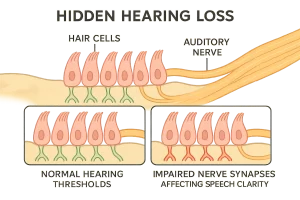
One of the most common causes ENT specialists see in the clinic is hidden hearing loss also called as synaptopathy.
Hidden hearing loss means your ear hears the sound, but the nerve signals are not strong enough, so words feel unclear, especially in noisy places
It occurs when the tiny connections between the inner ear hair cells and the hearing nerve, called synapses are damaged.
Why it Happens?
Hidden hearing loss can happen after loud noise exposure, ageing, viral infections, or sometimes without a clear reason.
What this means in real life:
You can hear soft sounds, but clarity drops, especially in noisy places.
Voices feel blurred instead of crisp
You keep saying “hmm?” even though sound is audible
A simple way to understand this: Volume is normal. Clarity is not.
If this sounds like your experience, ask for a Speech-in-Noise test or extended high-frequency (EHF) audiometry. There is no single gold standard test but these tests often reveal what a routine audiogram misses.
Auditory Processing Disorder (APD)
(Brain Having Trouble Processing the Sound)
Sometimes the problem is not in the ear, ear sends the sound correctly to the brain.
But the brain cannot process it quick enough, this is called Auditory Processing Disorder, or Central Auditory Processing disorders (CAPD).
APD occurs when the brain receives sound normally but cannot process it efficiently, especially in complex or fast conversations.
Why it Happens?
This difficulty can appear after viral illness, ear infections, migraine, prolonged stress, concussion, aging, poor sleep, or simply cognitive overload.
Symptoms patients notice:
Difficulty keeping up with fast speech / conversations
Words blending together or jumbling
Trouble following multiple people talking / in group settings
Feeling mentally tired after listening
Doing well in quiet, but struggling in noise
Mishearing similar words
High-Frequency Micro-Damage
(Extended High Frequency Hearing Loss)
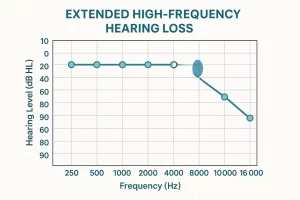
Standard audiometry checks sound up to 8 kHz frequencies.
Extra-high frequencies (10–16 kHz) help you catch sharp speech sounds, that makes speech clear.
If these are affected, your hearing may feel muffled.
Conversations, especially in noisy places, become harder to follow even if your audiogram is normal.
Why it happens?
EHF or High-frequency hearing losses (10–16 kHz ) can be the earliest sign of noise or age-related hearing change, even when routine audiogram (up to 8 kHz) looks fine.
It is common in people with headphone overuse or frequent noise exposure.
Action: Ask your audiologist for EHF testing if voices feel unclear or sharp sounds feel missing.
Adding extended high-frequency audiometry (EHF- 10–16 kHz) helps detect this hidden hearing loss, years before standard audiogram shows changes.
Middle Ear Issues After an Infection
Sometimes the middle ear doesn’t go back to “perfect normal” even after an ear infection has healed.
Mild inflammation, Eustachian tube blockage, or sticky mucus, can make sounds muffled, especially soft speech and conversations from distance.
If you’ve recently had a cold, allergy flare, or sinus congestion, this becomes even more likely.
Symptoms it’s the middle ear
Popping or crackling sounds
A sense of fullness or pressure
Hearing that fluctuates through the day
Action: Consider tympanometry or eustachian tube function tests if your hearing clarity changes or if you’ve had a recent ear infection.
Speech Discrimination Issues
(When You Hear the Voice but Miss the Words
Even when your pure tone audiogram is normal, your Speech Discrimination Score (SDS) may be slightly reduced.
This explains why you:
Hear the sound/Voices, but miss the word details or don’t catch the words
Especially children’s voices, soft speakers, or fast talkers
Clinically, lower-than-ideal SDS may begin affecting clarity.
Stress, Fatigue, Anxiety and Hearing Blur
On busy days, or anxious moments, patients often say, “Voices sound blurred even though my hearing test is normal.”
Patients experience:
Foggy hearing in the evenings
Difficulty concentrating on conversations
Missing words despite good volume
Feeling overwhelmed by multiple sounds
Try a 10-minute listening rest and note whether clarity improves.
This helps patients recognize when the issue is processing load, not ear damage.
Symptoms That Suggest Your Hearing Is Not as “Normal” as the Audiogram Shows
Checklist- Do These Symptoms Sound Like You?
You hear the sound but miss the words
You struggle more in crowds than quiet rooms
You hear better at home than in restaurants You keep increasing TV volume but still miss dialogues
You hear better one-to-one but not in groups
You feel the ear is “perfect” yet clarity is not
You avoid conversations because it drains your energy
Words feel muffled, unclear
Difficulty understanding fast speech, female voices, or speech in echoic spaces.
Your ears feel full or heavy
If you tick 3 or more of these, a detailed clarity evaluation (speech-in-noise, EHF, middle-ear check or BERA ) is recommended.
Why do I Hear Better at Home than in Restaurants?
Home listening is predictable, quiet, and low-echo. Restaurants have more reverberation, multiple voices, and mixed frequencies.
These conditions cause speech clarity issues that don’t show up on a routine audiogram.
Common Situations My Patients Share
Many of my patients describe these as speech clarity problems even when their hearing test looks normal.
You may relate to a few of these:
I hear people talking, but I can’t understand them in the marketplace.
I do okay on phone calls, but struggle face-to-face in noisy places.
My child’s voice sounds mumbled.
I keep asking people to repeat, even though I heard the sound.
I hear everything… but it doesn’t feel clear.
One patient once told me, I can hear my wife’s voice, but I cannot catch the meaning unless she slows down.
These clues guide the ENT specialist towards right clarity tests.
Tests That Help Assess Your Speech Clarity Problem
For patients who struggle despite a normal audiogram, useful tests are speech-in-noise testing, extended high-frequency audiometry, BERA and auditory-processing checks.
Speech-in-Noise Test (QuickSIN)
Speech-in-noise testing checks how well you understand speech with background noise. It detects: clarity loss in real-world listening like in restaurants, family gatherings, or meetings.
Speech-in-Noise Tests in India
Standardized speech-in-noise tests are not available in every Indian language.
Some languages like Hindi (Digit-in-Noise), Marathi (M-RAMSIN test), Tamil, Malayalam and Telugu now have validated versions, but their role in diagnosis is still being studied.
We interpret the results along with symptoms, high-frequency thresholds, and clarity tests.
Extended High-Frequency Audiometry (12-16 Hz)
Extended high-frequency audiometry, such as 10, 12 and 16 K, checks very high-pitch sounds that a routine audiogram does not measure. These often show the earliest micro-damage.
In children, high-frequency hearing loss can make soft speech sounds like s, sh, f harder to hear. This may his may show up as unclear speech or difficulty understanding teachers.
Adding high-frequency testing to routine checks helps us find the problems.
Otoacoustic Emissions (OAE)
Checks outer hair cell function, which plays a major role in sound sharpness and clarity.
Reveals hidden high-frequency loss missed by standard pure tone audiograms.
ABR or BERA
BERA (Brainstem Evoked Response Audiometry) checks how well the hearing nerve and brainstem respond to sound.
Tympanometry + Eustachian Tube Function Test
Useful when fullness, pressure imbalance or post-infection changes are suspected. It helps check middle ear function, eustachian tube block, middle ear fluid, any middle ear ossicle (hearing bone) damage or stiffness).
MRI (only if clinically necessary)
MRI scans are not routinely needed. Considered only when nerve pathway issues must be ruled out.
It detects structural or nerve-level abnormalities.
Cognitive Auditory Processing Evaluation
Auditory processing checks help us understand how well the brain handles sound, especially fast speech, accents, classroom noise, or situations where multiple people are talking.
these are some behavioral listening tests –
Gap Detection– How quickly you notice tiny gaps in sound
Dichotic Listening – How well you understand two different sounds presented to both ear.
Speech in Noise – How clearly you follow speech when there is background noise.
APD tests are supportive, not standalone.
Results are interpreted alongside symptoms, school or office listening difficulties, and high-frequency hearing results to get the full picture.
APD Tests in India
In India, full APD test batteries or detailed speech-in-noise testing in specific regional languages are available only at selected specialized audiology centers.
At my clinic, I provide the core diagnostic audiological tests you need – PTA, speech audiometry, tympanometry, extended high-frequency testing, OAE, BERA/ABR and ASSR.
If a deeper auditory-processing evaluation is required, I guide patients.
If your audiogram is normal but clarity still feels reduced, you can book an ENT consultation at our Vashi ENT & Hearing clinic.
How These Tests Work Together
A combination of speech-in-noise, extended high-frequency audiometry, BERA/ABR, OAE, and APD checks gives the clearest picture.
Together, they help detect hidden hearing or processing problems early, even when a standard audiogram looks normal.
How to Improve Hearing Clarity When the Audiogram Is Normal
If speech clarity remains poor despite a normal audiogram, it indicates the need for targeted evaluation and appropriate treatment.
Different underlying reasons need different management approaches, here is what usually helps.
Hidden Hearing Loss
Hidden hearing loss cannot be reversed, but daily clarity improves with noise-management, focused listening training, and sometimes, clarity-focused amplification even with normal thresholds.
What helps:
Protect your ears from loud noise even daily exposure matters.
Begin high-frequency listening exercises.
Train ear -brain coordination
Clarity-enhancing counselling
Sometimes hearing devices (only when indicated)
What to expect:
Most people feel conversations becoming a little less “blurred” once nerve strain reduces over a few weeks.
High-Frequency Micro-Damage
Extended high-frequency loss is permanent, but clarity-focused counselling and targeted rehab can make speech understanding easier in noisy places.
What helps:
Begin high-frequency auditory rehab to strengthen clarity cues.
Avoid long hours of headphone or loud music use.
Use noise protection devices
Auditory Processing Difficulty Disorder
Auditory processing difficulty is functional, not structural. Evidence shows that with auditory training, slower speech, and listening therapy most patients notice better real-life understanding.
What helps:
Listening therapy and structured auditory training apps.
Slow, spaced conversations pace at home and work to reduce processing load.
With training , you begin to feel less “tired from listening”, and fast conversations feel less overwhelming.
Treatment of Middle Ear Issues
Middle-ear related clarity problems usually improve well with correct medical treatment and tympanometry-guided follow-up.
Medication by ENT specialist, when indicated.
Eustachian tube exercises
Hydration, steam (if suitable).
Treating underlying allergy or sinus issues if present.
What to expect: A gradual shift from ‘muffled’ to ‘cleaner’ sound as middle ear pressure normalizes over 2-3 weeks.
Stress or Fatigue-Related Hearing Blur
Short listening breaks to reduce neural overload.
Improve sleep rhythm and hydration.
Music-therapy practices that calm the auditory pathway.
Mind-body calm techniques
What to expect
Even a few days of reducing overload brings noticeable relief in “hearing fog”and improves speech clarity.
Speech Discrimination issues
The ear hears the sound but misses the finer details of words.
What helps:
Targeted speech-clarity exercises (I guide these during counselling).
Listening practice in quiet → then gradually in soft background noise.
Structured communication strategies (face visibility, pacing).
What to expect: You begin catching the meaning faster, especially on phone calls.
When Do Hearing Aids Help in Speech Clarity?
At present, there are no hearing aids made specifically for extended-high-frequency loss or speech-in-noise difficulty when your regular audiogram is normal.
Research is ongoing on low-gain devices for people who struggle to hear in noise despite ‘normal’ hearing.
These devices are still being studied, and they are not routinely recommended until we have stronger evidence.
In Simple Words
Speech clarity improves once we find the exact reason and support accordingly. It need patience.
When to See an ENT Doctor?
Seek ENT evaluation even if audiogram report is normal if:
You hear but don’t understand
Hearing feels normal but clarity isn’t
Your speech clarity is still poor in noise
You feel listening fatigue or “processing strain”
You hear sounds but miss words, especially children/soft voices
You struggle more in restaurants than at home
You notice popping, fullness, or fluctuating clarity
Emergency red flags – when to act immediately: Sudden hearing drop. Severe vertigo. Bleeding or severe ear pain.
In Simple words:
A normal audiogram is only the first layer. Real-life speech clarity depends on how your ear, nerve, and brain work together.
When patients still struggle despite a “normal” report, these deeper tests help us see what the routine test cannot
This includes Speech-in-Noise, Extended High-Frequency testing, ABR and OAE.
At our Vashi ENT & Hearing Clinic, we work as a team of ENT specialist and Audiologist so you get a complete and accurate picture.
Yes. Even mild inflammation or ETD can make sounds muffled despite normal PTA.
About Me
Hi, I’m Dr. Archana Jhawar, an ENT specialist with over 24 years of experience. I specialize in tinnitus treatment, vertigo , ear care, and ear surgeries, practicing at Neoalta Clinic, Vashi, and Kokilaben Dhirubhai Ambani Hospital in Navi Mumbai. I’ve trained in vertigo management and Rational Emotive Behavior Therapy (REBT), combining science with compassion to offer holistic, evidence-based care. I’m passionate about writing, poetry, music, yoga, and photography.