
A home sleep study or lab polysomnography – which one do you actually need? If you’re struggling with loud snoring or waking up tired, choosing between these two tests can be confusing.
While both evaluate sleep-related breathing problems like sleep apnea, understanding which sleep study suits your symptoms helps in right next step. Read more about sleep apnea treatment in Navi Mumbai.
A home study, sometimes referred to as a “Level 2 sleep study,” is mostly enough to diagnose OSA (Obstructive Sleep Apnea); however, a more detailed Level 1 or lab polysomnography may be necessary for some cases.
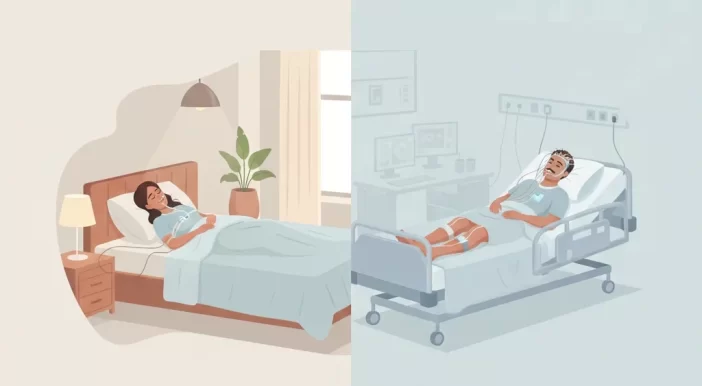
When doctors discuss sleep tests, they categorize them into four “Levels” based on the number of sensors used and the setting.
| Study Level | Location | Parameters Recorded (What is measured) | Supervision |
|---|---|---|---|
| Level 1 | Sleep Lab / Hospital | Full: Brain waves (EEG), Eye movement (EOG), Muscle tone (EMG), Heart (ECG), Airflow, Oxygen, Effort, Position, Snoring. | Continuous overnight technician. |
| Level 2 | Home | Full: Same as Level 1 (includes Brain waves, Muscles, and Heart). | None (Sleeps naturally at home). |
| Level 3 | Home | Limited: Only Airflow, Oxygen, Heart Rate, and Effort. (No brain waves). | None. |
| Level 4 | Home | Basic: Usually only Oxygen and Heart Rate. (Screening only). | None. |
Warning: These level-4 screening devices such as a simple pulse oximeter is not a complete sleep study and can miss up to 30-40% of Sleep Apnea cases.
A home sleep study, or Home Sleep Apnea Test (HSAT), is a comprehensive sleep evaluation used to detect breathing disorders while you sleep in the comfort of your own bed.
Typically known as a Level 2 or Level 3 sleep study, this test uses a portable device to record your breathing, sleep quality, heart rate, and oxygen levels without the need for an overnight stay in a hospital.
The main goal is to determine if your snoring is actually a sign of Obstructive Sleep Apnea (OSA).
Depending on the device used (Level 2 vs. Level 3), a home sleep study test typically records:
Brain Activity ((Level 2 only ) : 4 to 6 EEG sensors on the scalp to identify sleep stages (Light, Deep, and REM) and actual actual sleep-wake patterns.
Eye Movements (EOG): To precisely detect REM (Dream) sleep.
Muscle Tone (EMG): Sensors on the chin and legs to detect teeth grinding (bruxism) or Restless Leg Syndrome.
Airflow & Breathing pattern Sensors track your inhalation and exhalation to find pauses in breathing (apneas).
Oxygen Saturation (O2): A finger clip (pulse oximeter) monitors for drops in oxygen levels during snoring or gasping episodes.
Respiratory Effort: Belts around the chest and abdomen measure how hard your body is working to breathe.
Heart Activity (ECG): A continuous recording of heart rate and rhythm how your heart handles sleep stress.
Body Position: Identifies if your sleep apnea is “positional” (like worse on your back).
Snoring: Records the intensity and frequency of snoring sounds.
Home testing is the most convenient and cost-effective option for patients with a high probability of Obstructive Sleep Apnea (OSA).
It is ideal for those with symptoms like loud snoring and daytime fatigue who do not have complex health issues like heart failure or chronic lung disease.
Note on Accuracy: Most basic home tests (Level 3) only track breathing and heart rate. At our Vashi clinic, we utilize Level 2 Polysomnography for home testing.
This ‘Complete Sleep Study‘ includes EEG (Brain Activity) monitoring to provide lab-level accuracy without the stress or cost of a hospital environment.
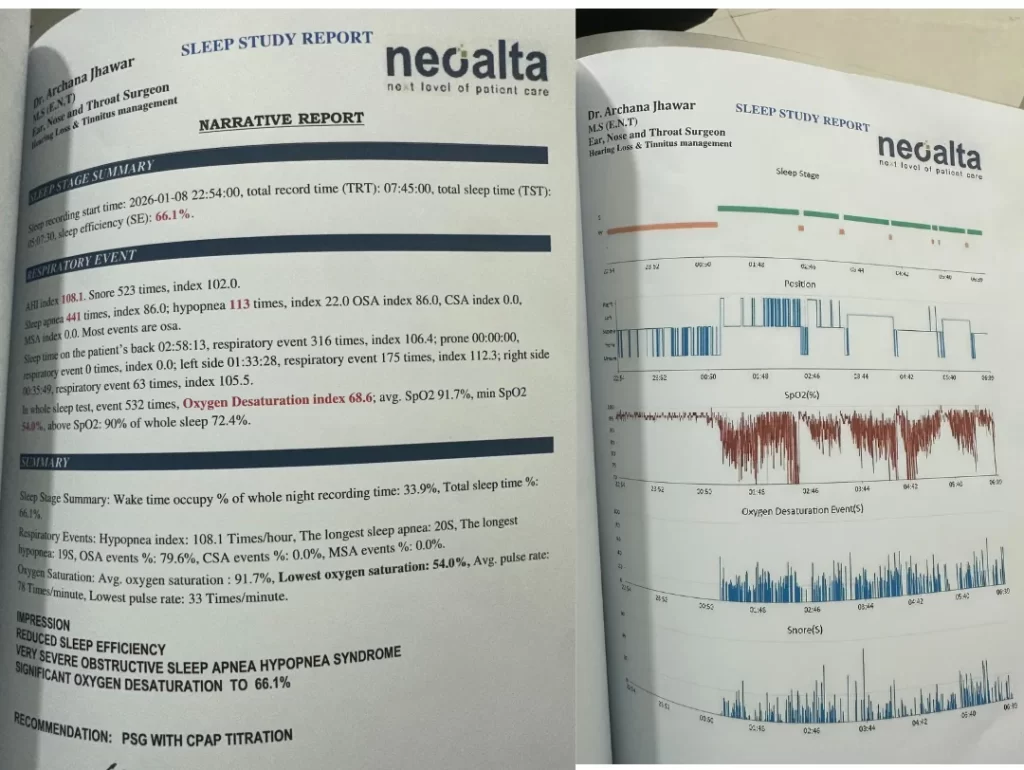
A lab polysomnography (PSG) is an overnight sleep study done in a specialized sleep lab or hospital under the continuous supervision of a trained sleep technician.
While a home test offers convenience, a lab study is the “gold standard” for accuracy because if a sensor or lead moves during the night, the technician can fix it immediately.
A level-1 Lab sleep Study monitors full range of parameters listed in level 2 sleep study above (EEG, EOG, EMG, ECG, etc.).
The primary difference from level 2 study is not the parameters but the presence of a trained technician who monitors the signals in real-time.
This allows for immediate sensor correction and specialized monitoring like CO2 gas exchange, making it the gold standard for complex medical cases.
Lab sleep studies are preferred for complex cases where precise signal control is essential. You should opt for a lab study if you have:
Complex Health Issues: Patients with significant heart failure or complex lung disease.
Specific Disorders: Suspected Narcolepsy or Periodic Limb Movement Disorder.
Inconclusive Results: Patients who have already had a home test that did not provide clear answers.
Both home and lab sleep studies are essential diagnostic tools, but they serve different patient needs. The difference is not about which test is “better”, but about which test fits your symptoms best.
A home sleep study is done in your own bed. It is convenient, closer to natural sleep without the “First Night Effect” (the difficulty of sleeping in a new place) often felt in hospitals.
A lab sleep study is conducted in a controlled hospital setting with continuous monitoring. It is preferred when symptoms are complex, where brain waves and movements need second-by-second supervision.
In simple terms:
Choosing the right study at the start improves accuracy, avoids repeat testing, and leads to quicker treatment decisions.
| Aspect | Home Sleep Study | Lab Sleep Study |
|---|---|---|
| Environment | Natural & familiar; your own bed. | Controlled clinical setting; hospital room. |
| Technical Setup | Self-applied or Technician-assisted at home. | Technician applies sensors in the lab. |
| Signal Fixes | None (If a wire moves, it stays off). | Real-time: Technician fixes sensors immediately. |
| Comfort | High; minimal disruption to your routine. | Lower; “First Night Effect” in a new place. |
| Cost | Significantly more affordable. | Higher (includes hospital stay & staffing). |
| Best Suited For | Standard Sleep Apnea (OSA) cases. | Complex heart/lung issues or mixed symptoms. |
Choosing the right sleep study improves accuracy and avoids the frustration of repeat testing.
Choose a Home Sleep Study if:
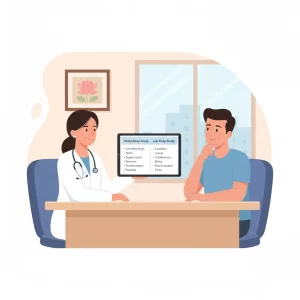
Choose a Lab Sleep Study if:
A Home Sleep Study is significantly more affordable than an overnight hospital stay.
A sleep study tells us what is happening while you sleep, but an ENT evaluation tells us why.
A level 2 sleep study in Navi Mumbai, records your breathing pauses and oxygen drops.
Dr. Archana Jhawar, ENT specialist in Mumbai with 24 years of experience in sleep apnea, performs an assessment of your “upper airway anatomy” to find the specific site of the blockage.
Common “Blockage” Points Identified:
Is your spouse complaining about your snoring? Record a 30-second audio clip of your sleep and bring it to your consultation. It provides vital clues to the specific site of your airway obstruction.
By combining Level 2 sleep data with a physical exam of your tonsils, septum, and palate, we create a treatment plan that actually fixes the root cause, whether it requires a CPAP machine, lifestyle changes, or a corrective surgical procedure such as septoplasty.
To understand how snoring and fatigue may be linked to breathing issues during sleep, you can also read:
Snoring, gasping, daytime fatigue – allergy or sleep apnea?
Don’t ignore the red flags of sleep apnea. Schedule an ENT consultation at our Navi Mumbai clinic to determine if a Level 2 home study or a lab evaluation is right for you.
Doctor’s Reply: A Level 3 study only monitors breathing and oxygen. A Level 2 sleep study is much more comprehensive because it includes EEG (brain wave monitoring).
This tells about sleep stages and hospital grade accuracy in the comfort of your own home.
Doctor’s Reply: A sleep study confirms if you have sleep apnea and how low your O2 levels drop, but an ENT evaluation identifies the blockage source.
By combining sleep data with a physical exam of your nasal septum, tonsils, and palate, we can determine exactly where the airway is blocked.
Doctor’s Reply: For most patients, a Level 2 home sleep study is just as accurate for diagnosing Obstructive Sleep Apnea (OSA).
It has the added benefit of recording your sleep in a natural environment, which often provides a more realistic representation of your typical breathing patterns.
Doctor’s Reply: Not necessarily. Depending on the sleep study results and the physical exam, treatment may include lifestyle changes, CPAP therapy, or corrective surgeries.
The goal of the ENT evaluation is to find the most effective, least invasive solution tailored for you

Hi, I’m Dr. Archana Jhawar, an ENT specialist with over 24 years of experience. I specialize in tinnitus treatment, vertigo , ear care, and ear surgeries, practicing at Neoalta Clinic, Vashi, and Kokilaben Dhirubhai Ambani Hospital in Navi Mumbai. I’ve trained in vertigo management and Rational Emotive Behavior Therapy (REBT), combining science with compassion to offer holistic, evidence-based care. I’m passionate about writing, poetry, music, yoga, and photography.
Home Sleep Study or Hospital Lab: Choosing the Right Test
Snoring, Gasping, or Fatigue: Is it Nasal Allergy or Sleep Apnea?
Nasal Allergy and Sleep Problems: Why You Feel Tired All Day
When Nasal Blockage Needs Surgery – And When It Doesn’t
Daily Allergy Triggers: Dust, AC, Pets, Pollen and What to Do