At my vertigo clinic in Navi Mumbai, I often meet patients who’ve spent months trying to figure out the reason of their dizziness or vertigo. A VNG test for dizziness examines eye movements to help your ENT identify whether the balance problem comes from the inner ear or another system.
Along with a thorough history and clinical examination, this simple, non-invasive test guides us toward the right diagnosis and treatment
This way VNG test guides most effective treatment, whether that’s repositioning maneuvers, medication, or vestibular therapy.
Table: VNG Findings and The Cause Of Dizziness
VNG Finding
What It May Indicate
Nystagmus triggered by position
BPPV
Reduced response on one side
Vestibular neuritis
Normal ear results but abnormal eye pattern
Central/neurological cause
In some cases, your ENT may combine VNG with other vestibular tests like vHIT (fHIT) or VEMP for a more complete evaluation, helping confirm the cause of dizziness and plan the most effective treatment.
What Makes VNG Different from Other Tests
VNG (Video-Nystagmography) is different from routine tests because it specifically looks at eye movements to understand how your balance system is working.
While a standard exam may show that you are dizzy, it often cannot explain why.
A VNG test for dizziness gives measurable information about how the inner ear and eye reflexes respond to movement.
Unlike MRI or CT which shows structure,VNG measures balance functions in real time.
This helps your ENT identify where the problem lies, whether the dizziness comes from the inner ear or another system.
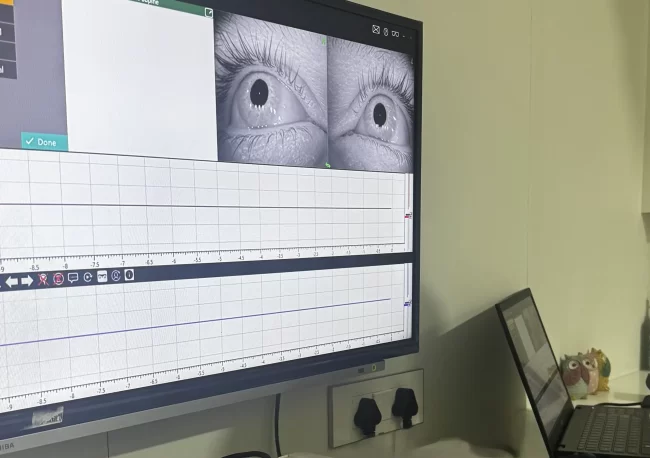
During the test, you’ll wear infrared goggles while your ENT guides you through simple visual and positional tasks.
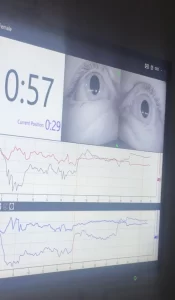
A VNG includes several parts such as saccade, smooth pursuit,optokinetic, vestibulo-ocular reflex (VOR), positional, positioning, SVV and caloric tests, each checking how your inner ear and eyes work together to maintain balance.
The test is safe, non-invasive, and usually takes about 45–60 minutes.
Some patients may experience mild, short-lived dizziness or nausea, particularly during the positional or caloric test, but these effects settle quickly.
Some patients worry the test might worsen their dizziness. But, VNG is safe, and designed to diagnose not distress.
For detailed guidance on how we conduct the VNG test at our clinic and preparation tips, read here → VNG test in Vashi, Navi Mumbai.
What Patients Feel After the VNG Test?
After the VNG test, some patients notice a little dizziness or mild unsteadiness, and few may feel slight nausea for a short time.
These happen more commonly after a caloric test.
These sensations are temporary and usually settle within a short time after the test.
There is no lasting discomfort, though some patients may feel light heaviness in the head for a day.
It is usually advisable to eat a light meal before the test to avoid vomiting, an antiemetic may be given if you already feel nauseated.
We recommend arranging someone to drive you home.
If repositioning maneuvers are performed, please read the blog on what to do after the repositioning maneuvers.
Understanding Your VNG Results
After the test, the recorded eye movements are carefully analyzed by your ENT or vestibular specialist.
Each part of the VNG test provides information on how well both inner ears respond, whether one side is weaker, and how your brain coordinates balance signals.
The report doesn’t just say “normal” or “abnormal.”, it identifies the area of dysfunction.
An abnormal VNG test report shows which part of your balance system is affected and how severe the dysfunction is.
When to Ask Your ENT About a VNG Test
You should consider discussing a VNG test with your ENT, If dizziness, spinning sensation or imbalance while walking just won’t go away.
It’s also recommended if you feel vertigo on changing position or with sudden movements.
If you have done MRI scans or audiometry. Results are normal and yet you experience vertigo.
The test is especially useful when symptoms overlap or when other routine tests don’t explain the cause.
Sometimes, what feels like “just vertigo” may have different underlying causes and identifying them early makes treatment faster and more effective.
VNG vs ENG Test
Another balance test is ENG(electronystagmography), which also measures eye movements to assess balance.
Instead of infrared goggles used in VNG, ENG uses tiny electrodes placed near the eyes.
ENG may be suggested in certain situations, for example if a patient finds goggles uncomfortable or has eyelids that partially cover the pupils.
In most cases, VNG is preferred because it is quicker, more comfortable, and gives a more precise picture of how your balance system is working.
How Early VNG Diagnosis Helped One of My Patients
A young woman came to the clinic with vertigo that had started just three days earlier. She felt a spinning sensation every time she lay down or turned to one side.
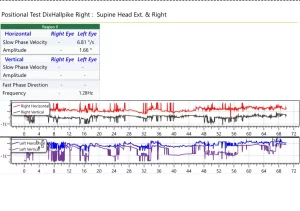
We performed a VNG test, which confirmed clear pattern of posterior canal BPPV, one of the most common inner ears causes of vertigo.
Right after confirming the diagnosis, I performed a repositioning procedure (Epley’s maneuver), and her vertigo resolved completely.
It’s a reminder that when vertigo is evaluated early with the right test, recovery can be quick, and unnecessary medication or anxiety can be avoided.
At Vashi ENT & Vertigo Clinic, every balance test is interpreted in context with your symptoms and medical history. So, you’re not just treating symptoms but addressing the root cause.
If your ENT recommends a VNG, you can also read more about how the test is done here → VNG Test in Navi Mumbai
VNG helps your ENT doctor find out whether the cause of dizziness is from the inner ear or the brain, and plan suitable treatment such as repositioning maneuvers, medication, or vestibular therapy
Not always. VNG is an important test for dizziness/vertigo. But sometimes, your ENT may suggest other tests like vHIT, VEMP, or posturography, MRI scans, or audiogram to assess your balance system.
VNG tests how your balance system functions. MRI and CT scans show structure, they help rule out brain or nerve causes. Many patients need both, but for different reasons. Your ENT guides which one fits your symptoms best.
Yes. Dizziness isn’t always from the inner ear, sometimes it’s linked to anxiety, blood pressure, migraine, or medication. In such cases, your ENT may suggest other tests to find the exact cause.
About Me
Hi, I’m Dr. Archana Jhawar, an ENT specialist with over 24 years of experience. I specialize in tinnitus treatment, vertigo , ear care, and ear surgeries, practicing at Neoalta Clinic, Vashi, and Kokilaben Dhirubhai Ambani Hospital in Navi Mumbai. I’ve trained in vertigo management and Rational Emotive Behavior Therapy (REBT), combining science with compassion to offer holistic, evidence-based care. I’m passionate about writing, poetry, music, yoga, and photography.

 A VNG includes several parts such as saccade, smooth pursuit, optokinetic, vestibulo-ocular reflex (VOR), positional, positioning, SVV and caloric tests, each checking how your inner ear and eyes work together to maintain balance.