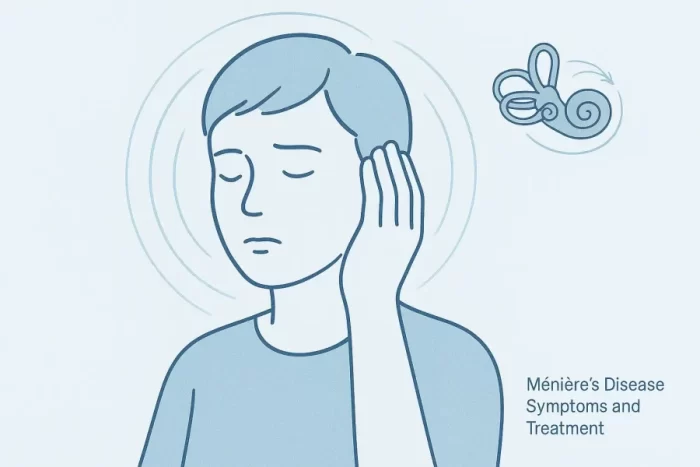
Could this be Ménière’s disease?” Many patients ask me this anxiously, as they describe spinning sensations, a sense of ear fullness, or ringing. Ménière’s disease (MD) is an inner ear disorder that can cause repeated dizzy spells, tinnitus, fluctuating hearing loss, and a feeling of pressure in the ear.
In this blog, we’ll look at what Ménière’s disease is, why vertigo keeps coming back, common symptoms, and the treatment options available.
Ménière’s disease (M.D.) is a chronic inner ear disorder that causes recurrent attacks of spinning vertigo, fluctuating hearing loss, a sense of ear pressure and ringing in the ear.
Ménière’s vertigo is believed to be caused by fluid buildup in the inner ear that impacts both balance and hearing.
What are the Common Symptoms of Ménière’s Disease?
Symptoms of Ménière’s Disease (or MD) includes.
Recurring Spinning Vertigo
Spinning episodes in Ménière’s last from minutes to hours.
Tinnitus
Ringing, buzzing, or humming in the ear, which may be constant or appear only during episodes.
Fluctuating Hearing Loss
Muffled hearing or hearing loss may start in one ear and usually fluctuates. Hearing loss may worsen and become permanent.
Ear fullness or pressure
A sense of “blocked” ear or pressure in the ear, often before a vertigo episode.
Nausea or vomiting
Nausea or vomiting may occur during vertigo attacks.
In early stages of MD, patients may not have all the symptoms.
Dop Attacks of Ménière’s
During advanced stages of the Ménière’s patients may abruptly fall. this is known as drop attacks or Tumarkin attacks.
What Causes Ménière’s Disease?
Dizziness in Ménière’s comes in sudden spells that are hard to predict. Means many patients feel fine for weeks, and then suddenly the spinning may start again.
Doctors don’t know the exact cause of Ménière’s disease, that’s why you may often hear the term “idiopathic” (meaning: unknown reason). Here’s what we know-
Why Does vertigo keeps coming back in Ménière’s?
Inner ear fluid imbalance (endolymphatic hydrops)
Normally, fluid in the inner ear sends signals to the brain to help keep our balance. In endolymphatic hydrops, there is accumulation of excess fluid in the inner ear. This fluid may create disturbance in balance and hearing systems.
Ménière’s patients often have endolymphatic hydrops. It is believed that sudden changes could trigger vertigo attacks rather than constant dizziness.
But we do not clearly know if this could be the reason of recurring vertigo episodes.
Everyday Triggers for Ménière’s
Certain lifestyle factors can affect the balance and bring on a new episode. These include too much salt in your diet, high stress, dehydration, fatigue, or poor sleep.
Managing these factors can sometimes reduce the frequency or intensity of attacks.
Coexisting Balance Disorders
Some people with Ménière’s disease also have additional balance issues like BPPV (positional vertigo),vestibular migraine, or PPPD (Persistent Postural-Perceptual Dizziness). When these overlap, vertigo spells can become more frequent, severe, or difficult to control.
In short, while the root cause may not always be clear, specialists believe a combination of inner ear fluid changes, genetic tendency, and certain triggers contributes to Ménière’s disease.
How is Ménière’s Disease Diagnosed?
Which Doctor to Consult?
If you’ve been experiencing repeated dizzy spells, ringing in the ear, ear fullness or hearing changes, the first step is to visit an ENT specialist, a vertigo expert or an oto-neurologist.
Ménière’s disease is diagnosed clinically, meaning there is no single blood test or scans to confirm this. Instead, a vertigo-specialist combines your symptoms, hearing tests, and balance results.
Key Diagnostic Steps:
ENT or neuro-otologist evaluation
Hearing tests to detect fluctuating hearing loss
VNG (Videonystagmography) or Posturography to assess vestibular function
MRI scans in selected cases to rule out other condition
Here’s what usually happens in Vertigo clinic to diagnose someone with spinning vertigo as Ménière’s Disease.
Detailed history of vertigo episodes
Our ENT doctor will ask many questions about your symptoms such as how often vertigo comes, how long it lasts, and whether it links with tinnitus or hearing loss.
Ear and balance check
Next our ENT will check your ear, nose and throat and perform simple clinical balance tests.
Periodic Hearing test (audiometry)
Audiometry may be advised, this helps confirm the fluctuating hearing loss typical of Ménière’s.
Additional audiological tests such as cVEMP, oVEMP or EcochG may be advised sometimes.
Balance tests (VNG)
Videonystagmography (VNG) show how your inner ear and brain work together during movement.
MRI scans
Sometimes imaging scans are advised, not to “prove” Ménière’s, but to rule out other conditions that may look similar.
Key take away :
Diagnosis of Ménière’s disease is mostly clinical, based on your symptoms and made by a specialist.
That’s why seeing the right doctor for Ménière’s (an ENT or neuro-otologist) matters, it avoids misdiagnosis and gets you on the right treatment path sooner.
Treatment Options for Ménière’s Disease
(What Really Works)
Quick summary of Ménière’s Disease Treatment
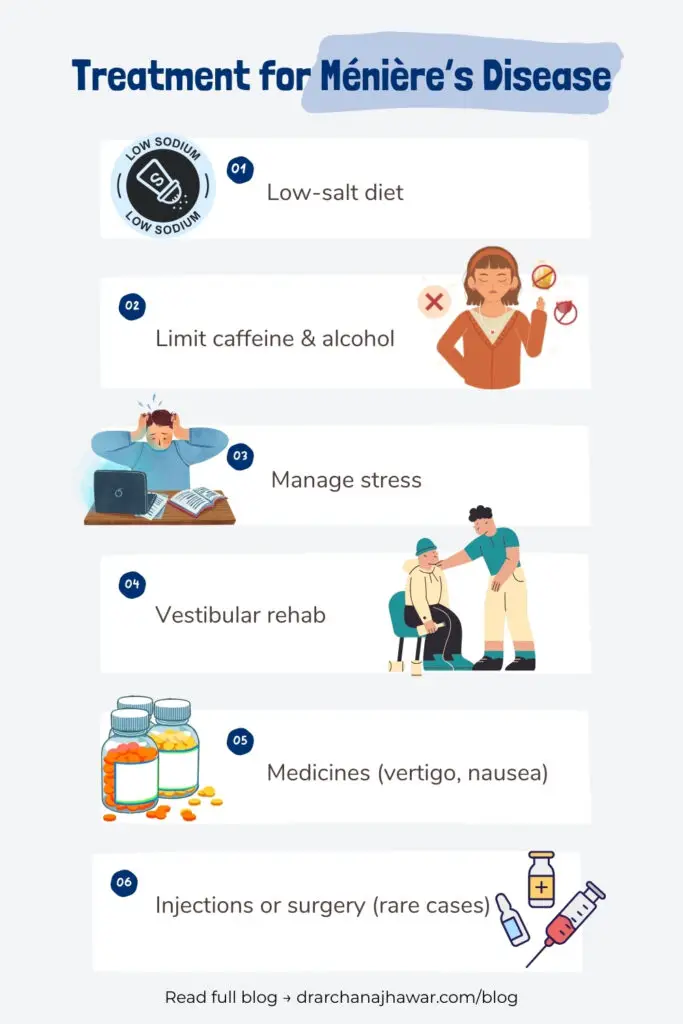
Healthy Lifestyle and diet Medicines – Vestibular suppressants and Diuretics Vestibular Rehabilitation Hearing support Intratympanic injections Surgeries
There is no cure for Ménière’s disease, but symptoms can be managed by medication, vestibular rehabilitation exercises, lifestyle changes or in rare cases, surgery.
MD treatment usually focuses on: controlling vertigo episodes, protecting hearing, managing tinnitus and improving quality of life.
Treatment of Ménière’s Attack
Here’s how an ENT or vertigo specialist may treat you during an acute Ménière’s attack-
Medicines:Your doctor may prescribe medicines to provide you with relief from distressing symptoms or help prevent attacks.
Medicines which works for Ménière’s are vestibular suppressants (for example Betahistine), Diuretics to lower the fluid buildup in the inner ear, and anti-nausea medicines to help with nausea and vomiting.
Healthy Lifestyle and Diet Changes: Simple healthy changes in daily routine often helps, such as – Low-salt diet Adequate water intake Stress management and regular sleep symptom diary helps identify patterns and manage them Limit caffeine and alcohol
These do not cure the disease but help control symptoms during an acute attack.
Vestibular Rehabilitation Therapy
VRT is an important part of managing Ménière’s disease or vertigo and dizziness due to any cause. These are targeted exercises to retrain our brains balance system. VRT helps in brain’s natural compensation mechanism to Improve stability.
Consistent VRT can reduce frequency of Ménière’s disease episodes.
Hearing Loss Management
Hearing aids are helpful if hearing loss is present.
Tinnitus Treatment
Sound therapy, TRT, CBT may be useful to manage the distress due to tinnitus.
Advanced Options (for severe or resistant cases of Ménière’s disease)
If symptoms persist despite treatment of Ménière’s disease, your ENT doctor may recommend-
Intratympanic steroid or gentamicin injections
Surgery like endolymphatic sac decompression or labyrinthectomy
The most important thing is that treatment of Ménière’s disease is never one-size-fits-all. It behaves differently in every patient, which is why a specialist’s guidance matters.
Understanding your triggers and learning to manage them is just as important as the medical treatment. This is often where patients feel more empowered, instead of helpless.
To lower the risk of repeated episodes doctors may prescribe medicines, VRT and suggest lifestyle adjustments, such as a low-salt diet, proper hydration, stress management, and sleep hygiene, which are equally important for prevention.
Living With Ménière’s Disease
These tips usually helps deal with MD-
Plan ahead with your steps about what to do if vertigo starts, like sitting or lying down safely.
Talk to family, friends, or Ménière’s support groups for help with anxiety and lifestyle changes.
Check-ups with an ENT or vertigo specialist help monitor your condition.
Follow doctor’s advice, treatment and vestibular rehabilitation exercises consistently.
Outcome & prognosis:
There is no cure for MD. It is disease which worsens with time. Few people may face challenges coping with it but many people with MD live a nearly normal life.
After a few years (approximately in 5-15 years) these acute vertigo attacks stop, however mild imbalance may continue. Hearing loss is usually progressive and tinnitus can be managed by CBT and sound therapy.
Living with Ménière’s disease can feel unpredictable, you never know when the next spinning attack might strike. But with the right treatment plan, most people can reduce both the frequency and intensity of episodes.
Further help with Ménière’s disease
FAQ about Meniere's Disease, Symptoms, Causes and Treatment
Yes, for many people. Too much salt, alcohol, or even too much coffee can make fluid changes in the inner ear worse and trigger Ménière’s attack. It’s not the same for everyone, but diet is worth tracking.
In the early stage of menieres, hearing may come back after an attack. Over the years, some patients do develop more lasting loss. Regular hearing checks help to catch this early..
Yes, light exercises for balance or yoga may help, like standing on one leg or turning your head slowly side by side or up and down while focusing on an object. For better results, most patients benefit learning these vestibular rehabilitation exercises with a trained vestibular therapist.
Certain medicines like diuretics or betahistine are sometimes prescribed daily. They don’t cure the disease but can reduce how often Ménière’s attacks come. Healthy lifestyle habits also helps.
Ménière’s usually does not disappear fully. Some patients may not get any dizziness attack for a long period but usually this tend to recur. We can reduce the frequency of these vertigo attacks with treatment and life style changes.
About Me
Hi, I’m Dr. Archana Jhawar, an ENT specialist with over 24 years of experience. I specialize in tinnitus treatment, vertigo , ear care, and ear surgeries, practicing at Neoalta Clinic, Vashi, and Kokilaben Dhirubhai Ambani Hospital in Navi Mumbai. I’ve trained in vertigo management and Rational Emotive Behavior Therapy (REBT), combining science with compassion to offer holistic, evidence-based care. I’m passionate about writing, poetry, music, yoga, and photography.