
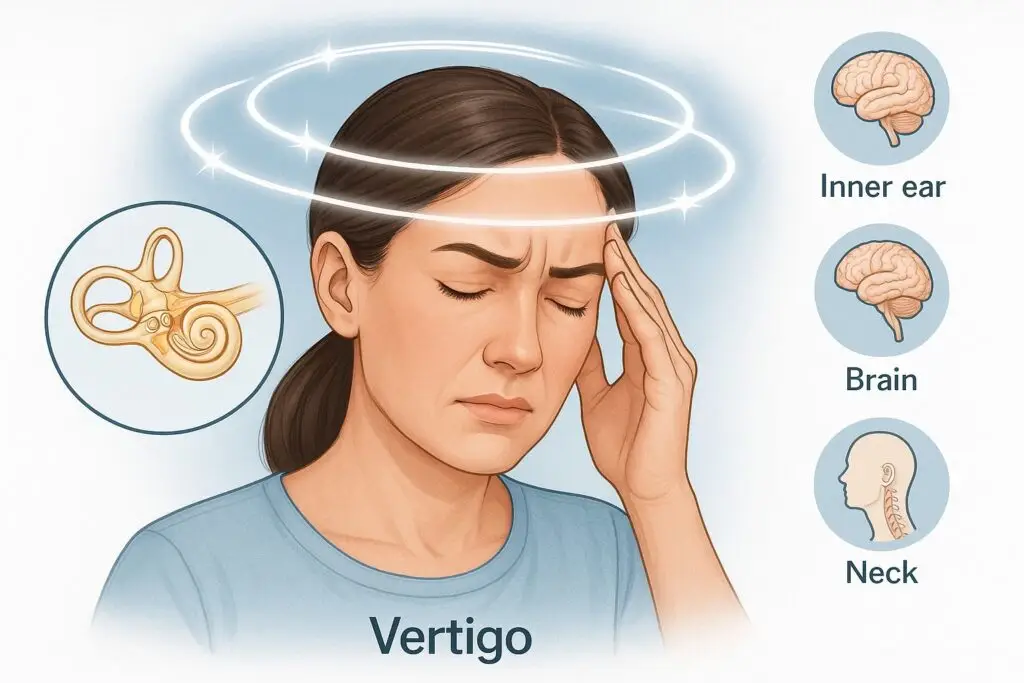
Vertigo is not a disease; it’s a symptom like pain or fever. It gives the strange sensation that either you are moving or the world around you is spinning, even when you’re still.
It may last just few seconds or stretch to hours, can come suddenly or gradually.
Some people may experience nausea, vomiting, hearing loss, imbalance or a buzzing sound in the ears (tinnitus).
Vertigo often signals a problem in the inner ear or brain areas that control balance. Think of it like your body’s internal GPS losing its signal.
Common Symptoms:
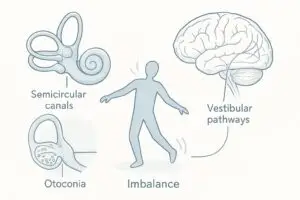 So, what are the causes of vertigo in adults?
Most of the time, it begins in the inner ear, but not always. Here are the most common causes I see at my clinic from inner ear to brain, neck, and anxiety.
Most cases of vertigo originate from the balance organs in the inner ear known as vestibular system. These conditions are often sudden, scary, but highly treatable when diagnosed correctly and early by a trained ENT or vertigo specialist.
It is the most common cause of vertigo.
Caused by tiny calcium crystals in the inner ear (otoconia) get dislodged and float into balance canals – the semicircular canals.
This cause sudden, brief but intense spinning when you lie down, turn in bed, turn your head, or look up.
This is one of the most treatable forms of vertigo often resolved with positioning maneuvers like Epley maneuveres.
A viral infection of the inner ear or balance nerve (vestibular nerve).
Leads to sudden, severe spinning vertigo with nausea and imbalance and a “sea-sick” feeling, Often comes after a cold or viral illness.
Labyrinthitis may cause hearing loss, neuritis does not. Managed by medicines and VRT.
Caused by fluid imbalance in the inner ear.
Presents as episodes of vertigo, fluctuating hearing loss, feeling of fullness in the ear, and tinnitus.
Not curable but manageable, symptoms can be reduced with salt restriction, pharmacotherapy and vestibular rehabilitation therapy
Past ear surgeries, trauma, or even chronic ear infections can disturb inner ear balance organ function and trigger vertigo episodes.
Dizziness may appear weeks or months after the ear problem began.
When vertigo arises from the brain or central nervous system, it may signal something more serious.
Serious neurological causes are less common, but important to rule out, especially in older adults or those with other health conditions.
A migraine variant that affects balance with or without a headache.
Causes dizziness, sound/light sensitivity, anxiety, and “aura” symptoms like visual flashes or brain fog.
Often mistaken for inner ear vertigo, but needs neurological evaluation.
In older adults, vertigo may rarely signal a small stroke (TIA) or early signs of a major stroke event.
If dizziness is sudden and comes with slurred speech, imbalance, double vision, or weakness, get immediate help especially in people with high blood pressure or diabetes.
Rarely, vertigo can be an early sign of neurological diseases, such as Multiple Sclerosis and Brain tumors (acoustic neuroma or others).
These are uncommon, but a thorough ENT and neurological evaluation helps rule them out.
These are usually accompanied by other symptoms like numbness, imbalance, or eye movement issues.
Some patients continue to feel dizzy even after the ear or brain has physically recovered. This is called functional vertigo, where the balance system gets stuck in alert mode and brain continues to perceive imbalance.
Often triggered by an initial vertigo attack (like BPPV or neuritis or prolonged stress.).
The brain remains hyper-alert even after the physical cause is resolved.
Patients feel unsteady, foggy, or motion-sensitive, not spinning but floaty most of the day.
Made worse especially in supermarkets, crowds, or scrolling on screens.
Anxiety can mimic, trigger or worsen dizziness.
This presents as light-headedness, shakiness, swaying or walking on clouds especially in stressful situations.
People feel dizzy when the brain struggles to process fast visual stimuli like scrolling screens, bright lights, or traffic.
It often overlaps with migraine or PPPD and is treated with graded exposure therapy and vision-vestibular rehab.
Not all dizziness comes from the ear or brain.
Some systemic health issues such as Low blood pressure, anemia, dehydration, cervical spine issues, or B12 deficiency can affect balance especially in older adults or in those with multiple health issues.
Can cause brief blackouts or dizziness, especially when standing up suddenly, condition known as postural hypotension . Its a known side effect of some blood pressure medicines.
Low levels of vitamin B12 can cause brain fog, imbalance, and tingling , often seen in vegetarians or those with poor absorption.
Cervical vertigo is usually seen in those with poor posture, neck stiffness, or screen overuse. It can affect the blood flow or sensory input needed for balance.
Treatable with neck physiotherapy and vestibular rehab.
Certain antibiotics (like gentamicin), chemotherapy drugs (like cisplatin), or diuretics can damage the inner ear’s balance system.
If dizziness starts after starting a new medicine, always inform your doctor. Early detection can prevent long-term damage.
Some auto immune conditions such as rheumatoid arthritis or lupus can sometimes affect the inner ear leading to hearing loss, pressure, or imbalance.
These are rare but important to detect early.
There are 100+ known causes of vertigo, but most patients don’t need 100 tests.
People need thorough consultation with some vestibular expert who knows where to look to know the cause of the vertigo.
Usually, diagnosis of the cause of vertigo is by history around the episode. That’s why you will find your neurotologist asking you many questions… like-
Also, if it is associated with nausea, vomiting, headache, anxiety, lack of sleep, difficulty in walking, loss of consciousness, ringing in ears or hearing loss.
We start with a detailed history: vertigo onset, duration, triggers, associated symptoms
Your ENT or vertigo specialist will perform clinical testing to check ear, eye movement and nystagmus, your nerves, your positional tests etc.
Checking your physical stability and how you walk to identify the type of imbalance.
A quick movement test to check how well your eyes stay fixed on a target while your head moves.
Specific head movements used to trigger symptoms and confirm if crystals are dislodged in the inner ear.
Evaluating the coordination between your eyes and inner ear to ensure your vision stays clear during head motion.
If needed, we may advise certain advanced audiological & vestibular tests to pin-point the exact location of the balance disorder:
to check if hearing is affected, which helps differentiate between conditions like Meniere’s Disease and Vestibular Neuritis.
The gold standard for vertigo diagnosis, including positional tests and, if required, caloric tests to check individual ear function.
A specialized test to measure how well you maintain balance under different sensory conditions.
Advanced high-speed camera testing to assess the Vestibulo-Ocular Reflex (VOR) across all six balance canals.
Specific tests to assess the health of the saccule/utricle and to check for fluid pressure (hydrops) in the inner ear.
Sometimes ENT doctor or Neuro-otologist may ask for MRI or may ask for opinion of neurologist or cardiac specialist when red flags are present or we suspect brain or cardiac involvement like sudden hearing loss, double vision, severe imbalance, cardiac arrythmias or risk factors for stroke.
Every dizziness is not vertigo, and every vertigo doesn’t need a scan.
Many patients ask me can anxiety cause vertigo symptoms? The answer is yes, anxiety can cause or worsen dizziness, however, it’s important to first rule out physical causes.
Sometimes, anxiety and vertigo feed into each other. You feel dizzy → you get anxious → anxiety triggers more dizziness → now you’re unsure what’s real.
As an ENT & Vertigo specialist and certified REBT (CBT) therapist, I often see that emotional stress increases perceived spinning. This is why mental rest and reset is important in vertigo treatment.
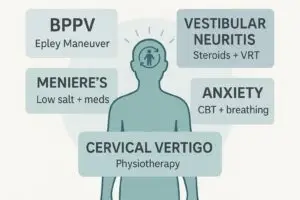
Once we identify the root cause, most vertigo cases can be treated effectively often without surgery or lifelong medication.
Following are treatment options for vertigo and approach at our clinic:
BPPV is treated using head positioning maneuvers that guide inner ear crystals or calcium particle back to place. Usually doesn’t require anti-vertigo medicines.
Epley Maneuver (CRP)– A guided head movement that repositions inner ear crystals. Often cures vertigo in 1–2 sessions.
Semont Maneuver – An alternative to Epley, especially effective in certain posterior canal BPPV cases.
Brandt-Daroff Exercises – Gentle, home-based movements that help reduce recurrence and desensitize the balance system.
These techniques work best when done under supervision.
Read my blog explaining how canalliths (calcium carbonate crystals) cause BPPV, what is positional vertigo and a detailed guide on BPPV Treatment : Canalith Repositioning Maneuvers, including Epley, Semont, Lempert (BBQ Roll).
Treatment of vertigo due to vestibular neuritis or labyrinthitis focuses on easing the initial spinning and helping the brain re-learn balance through vestibular rehabilitation therapy.
Early rehab (VRT) improves recovery and prevents long-term imbalance or development of PPPD.
The goal of treatment of Minière’s disease (MD) is to reduce inner ear fluid pressure and manage the long-term impact on hearing and balance.
Aim is reducing frequency and severity of attacks while preserving inner ear function.
Anxiety -related dizziness is treated with a combination of CBT, vestibular rehabilitation, gradual exposure for slow desensitization and medicine for co-existent anxiety or depression.
The brain’s balance system is deeply connected to our thoughts and emotions. Healing both creates lasting change.
For cervical or neck-related imbalance, treatment starts with posture and physiotherapy to reduce strain on balance pathways.
Some patients have more than one contributing factor like BPPV combined with anxiety, or Meniere’s along with VM or cervical stiffness. This is called mixed vertigo, and it’s more common than most people think.
Treatment for vertigo is to be tailored based on all possible causes and trigger. For example, we may combine head maneuvers, postural rehab, and CBT tools depending on what’s driving the dizziness.
That’s why getting the right diagnosis is the real first step to freedom from dizziness or vertigo.
Our brain has remarkable ability to compensate and same is true for our balance system. Whenever one of the organs of balance is not functioning normally, our brain usually adapts to the new situation and regains balance.
Vestibular rehabilitation training or VRT is repeated, brain-based retraining of vestibular system.
_______________
Need expert help? Visit our Vertigo & Dizziness clinic in Navi Mumbai.
You can read more about Vertigo & Dizziness treatment to understand better.
If you’re feeling dizzy or experiencing vertigo, you’re likely wondering: Is it from the ear or the brain? Should I consult an ENT or neurologist?
As a vestibular-trained ENT, I help answer these because the treatment varies based on whether it’s ear-related, neurological, or something else.
Not all vertigo is minor or due to BPPV. If you’re feeling off-balance daily, experience sudden hearing loss, or have constant spinning that lasts for hours or is paired with neurological symptoms like double vision, don’t delay.
These symptoms could mean something more serious like mini stroke or brain stem problem.
Taking vertigo tablets without knowing the cause may give short-term relief, but it often masks the real issue. Like guessing and self -medication can delay simple, effective treatments like a quick repositioning maneuver in BPPV.
A trained ENT with vestibular expertise can identify whether your vertigo is from the inner ear, brain, neck, or anxiety. We focus on the root cause not just symptom relief so your balance system can be restored.
After understanding the possible causes and treatments, it’s equally important to choose a doctor who knows how to connect the dots, from symptoms to the root cause of vertigo to the treatment.
When you feel dizzy, remember to visit an ENT specialist, neuro-otologist, or vestibular specialist.
Early diagnosis leads to faster, more effective treatment.
Here’s what I offer as an ENT and certified vertigo specialist in Navi Mumbai:
This guide is here to help you understand your vertigo symptoms, causes and treatment options better. If you’d like to learn more, or if you’re unsure whether what you’re feeling is vertigo, I’ve shared more insights in other blogs too.