Vestibular Neuritis: A Common Cause of Sudden Vertigo
Entdocnavimumbai
Vertigo-Expert
A sudden spinning vertigo, nausea, vomiting, finding hard to focus, or struggle with simple tasks like walking to the bathroom. This is often how vestibular neuritis begins- an inflammation of the balance nerve in the inner ear, usually after a viral infection.
Early treatment with medicines and vestibular rehabilitation exercises brings early relief and faster recovery from vestibular neuritis. This blog explains symptoms of vestibular neuritis, causes, how it is diagnosed and how it is treated.
Vestibular neuritis is third common causes of sudden vertigo related to inner ear. Also known as vestibular neuronitis or peripheral unilateral vestibular loss or unilateral vestibulopathy, it commonly occurs with or after a viral cold and affects vestibular nerve- the 8th nerve that helps control balance.
It is inner ear infection and not same as middle ear infection which affects ear drum surrounding middle ear area.
Though the dizziness in vestibular neuritis can be intense, it is not life-threatening and responds well to early medical treatment and vestibular rehabilitation therapy.
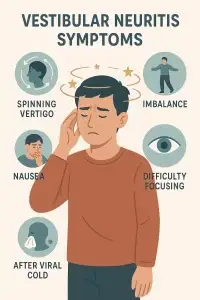
The symptoms of vestibular neuritis usually appear suddenly with sudden vertigo, often within hours, and may follow a recent viral illness.
It has an acute phase and a chronic phase. Initial sudden, severe vertigo symptoms last for about one week, followed by milder symptoms for a few weeks to several months.
Acute Stage (Sudden Vertigo)
Common signs of this acute vestibular syndrome include:
Sudden vertigo a spinning or rotation sensation that may last for hours or days
Loss of balance or unsteady gait
Nausea and vomiting, especially with head movement
Blurred vision or difficulty focusing
Dizziness that worsens with movement
In labyrinthitis vertigo, above vertigo symptoms are often accompanied by:
Hearing loss in one ear
Ringing (tinnitus) or ear fullness
Unlike ear infections or labyrinthitis, hearing usually stays normal in vestibular neuritis.
Chronic Vestibular Neuritis Symptoms
Symptoms of vestibular neuritis usually improve in a week or two. However, even after the severe spinning subsides, mild imbalance, unsteadiness or motion sensitivity may persist for a few weeks to few months. That’s when vestibular rehabilitation becomes important.
Vestibular Neuritis vs Labyrinthitis
Vestibular neuritis and labyrinthitis both cause sudden vertigo, lasting hours to days followed by imbalance.
Vestibular neuritis involves only vestibular part of inner ear or 8th cranial nerve. When this inflammation also affects the cochlear or hearing part of the inner ear nerve, it’s called labyrinthitis, slightly more severe condition that causes both dizziness and hearing loss/tinnitus.
Ramsay Hunt Syndrome– It is caused by shingles virus and it affects both 8th cranial nerve (vestibulocochlear) and 7th nerve (Facial nerve). That’s why along with vertigo, and single-sided hearing loss there is one sided facial paralysis, ear pain and rash in the ear.
In simple terms, vestibular neuritis affects your balance, while labyrinthitis affects both balance and hearing.
Causes of Vestibular Neuritis (VN)
Vestibular neuritis most commonly occurs along with a viral infection such as a cold, flu, sore throat, or upper respiratory illness. It can be caused by herpes virus, shingles or covid -19 virus.
When the virus spreads to the inner ear, it can cause swelling around this balance nerve, disrupting the brain’s ability to interpret motion signals. This leads to sudden dizziness, imbalance, or spinning sensations without any change in hearing.
Rarely, it may be associated with bacterial infections, autoimmune reactions, or, vascular issues affecting the inner ear.
Important: Vestibular neuritis or labyrinthitis is not caused by strokes or brain tumors, although sudden dizziness can be alarming and sometimes could be due to stroke or other acute neurological emergencies.
Proper diagnosis by an ENT specialist is critical for accurate vestibular neurites treatment.
Diagnosis of Vestibular Neuritis
you should visit an ENT specialist (otorhinolaryngologist) to get a diagnosis of vestibular neuritis. Sometimes, he may refer you to neurologist or an audiologist.
History of vertigo symptoms and vestibular examination helps in differentiating vestibular neuritis from other causes of vertigo.
Symptoms of Vestibular Neuritis
Your ENT doctor will ask about sudden vertigo, dizziness, imbalance, blurring of vision, difficulty in focusing, any recent viral illness, nausea, hearing issues.
Doctor will take a note of any red flag symptoms such as double vision or loss of consciousness to see for any neurological cause acute vertigo.
Clinical Examination for Acute Vertigo patient
The ENT doctor will perform a thorough vestibular examination.
Clinical tests, such as the Head Impulse Test (HIT), observing nystagmus (involuntary eye movements) and skew deviation tests, helps in diagnosing vestibular neuritis – these three tests together known as HINTS exam.
HINTS is simple bedside method used in acute-onset vertigo or dizziness to differentiate peripheral vertigo such as vestibular neuritis from serious neurological cause, like stroke.
Eye Movement or VOR
A key role of our vestibular system is to keep our vision steady while we move, known as the vestibulo-ocular reflex (VOR). In vestibular neuritis, the balance nerve on the one side is weak, which affects these stabilizing eye movements.
In the early phase, these small eye jerks (nystagmus) can often be noticed by the doctor without any equipment. But later, they may only be seen with infrared goggles during a vestibular examination. Checking these eye movements or VOR helps the ENT specialist understand which side is affected and it is important component to assess vestibular function in an ENT & vertigo clinic.
Advanced Vestibular (balance tests) Tests
Tests such as VNG, caloric test or VEMP may be recommended to diagnose the cause of acute vertigo. Caloric test, where hot and cold water is instilled in the ear canal, is specially useful in diagnosis of vestibular neuritis.
Hearing Tests
Your ENT may advise an audiometry test to check for any hearing loss.
MRI Scans
MRI brain CISS or MR Angiography may be advised to rule out neurological cause of vertigo such as stroke, TIA, tumor or head injury.
Early diagnosis of vestibular neuritis ensures timely treatment reducing the intensity of vertigo symptoms and faster recovery.
Treatment of Vestibular Neuritis
After ruling out serious neurological conditions causing sudden vertigo, treatment is started.
Goal of vestibular neuritis treatment is to reduce symptoms and help in faster recovery. Combined treatment with medicines and vestibular rehabilitation therapy brings faster relief from vertigo.
Your doctor may prescribe medicines to relieve nausea, dizziness, or inflammation. Commonly prescribed medicines-
Vestibular suppressants or anti histamines – For severe spinning and stressing vertigo vestibular suppressant such as Betahisitne may be given for a very short period. These are given for initial few days only as these interfere with natural compensation of our brains balance systems.
Anti-nausea drugs – these are given to reduce nausea and vomiting.
Short courses of steroid – Doctor may give short course of corticosteroids to reduce vestibular nerve inflammation.
Antiviral medicines if needed – for herpes virus vestibular neuritis, acyclovir or other antiviral medicine may be given.
Vestibular Rehabilitation Therapy for Vestibular Neuritis
VRT is a set of specialized exercises to retrain your balance system. Vestibular neuritis is loss of nerve signals but our brain has neuroplasticity where new connections are formed.
Gaze stabilization exercises – training your eyes to move smoothly while your head moves
Balance training – Improving posture, coordination, and stability
Gradual exposure – slowly reintroducing motions that trigger dizziness.
Vertigo due to Vestibular neuritis is treatable with medicines and balance exercises.
Early treatment and regular balance exercises at home, guided by your ENT, physiotherapist, or vestibular therapist accelerates recovery from vestibular neuritis dizziness.
Recovery and Prognosis of Sudden Vertigo d/t Vestibular Neuritis
Most vestibular neuritis patients start improving within a few days though full recovery from vertigo can take several weeks. Dizziness may be severe initially but slowly becomes less.
Some patients may feel mild unsteadiness, especially when moving quickly, for a few weeks.
Early rehabilitation exercise speeds up recovery and helps in preventing complications such as development of persistent dizziness or PPPD.
Tips to Support Recovery:
Follow your vestibular exercises consistently at home.
Avoid prolonged bed rest; gentle movement aids brain adaptation.
Book your consultation at our Vashi Vertigo Clinic for a complete sudden vertigo evaluation.
Most patients with vertigo because of vestibular neuritis recover fully within weeks, but some may have dizziness or unsteadiness for a few months. Early exercises for vertigo (VRT) helps in speedy recovery.
No. Vestibular neuritis affects only the balance nerve, while labyrinthitis affects both balance and hearing, sometimes causing ringing or hearing loss.
Medicines such as vestibular suppressants, anti-emetics and steroids may be given for relief from severe dizziness and nausea from vestibular neuritis initially, but for long term recovery vestibular rehabilitation exercises are essential.
When Should I See a doctor for Dizziness/vertigo ?
You should seek opinion of a vertigo expert if vertigo or dizziness is sudden, severe, or persists for days. Early vertigo treatment is essential for better outcome.
Certain neurological conditions like cerebellar or brain -stem stroke can present with sudden vertigo or dizziness symptoms, so urgent assessment is import.
Which doctor I can visit for vertigo due to vestibular neuritis in Navi Mumbai?
You can visit Dr. Archana Jhawar, ENT & Vertigo Specialist in Vashi, Navi Mumbai for vestibular neuritis or sudden vertigo treatment.
At our Vashi vertigo clinic, we specialize in managing vertigo and dizziness with a mix of vestibular rehabilitation, and gradual exposure.
Hi, I’m Dr. Archana Jhawar, an ENT specialist with over 24 years of experience. I specialize in tinnitus treatment, vertigo , ear care, and ear surgeries, practicing at Neoalta Clinic, Vashi, and Kokilaben Dhirubhai Ambani Hospital in Navi Mumbai. I’ve trained in vertigo management and Rational Emotive Behavior Therapy (REBT), combining science with compassion to offer holistic, evidence-based care. I’m passionate about writing, poetry, music, yoga, and photography.


 It has an acute phase and a chronic phase. Initial sudden, severe vertigo symptoms last for about one week, followed by milder symptoms for a few weeks to several months.
 When the virus spreads to the inner ear, it can cause swelling around this balance nerve, disrupting the brain’s ability to interpret motion signals. This leads to sudden dizziness, imbalance, or spinning sensations without any change in hearing.