
Home Sleep Study vs Lab Sleep Study: Which One Do You Really Need?
- Entdocnavimumbai
- Sleep Apnea
Last Updated: June 2026
A home sleep study or lab polysomnography – which one do you actually need?
If you’re struggling with loud snoring, daytime fatigue, or waking up tired despite adequate sleep, choosing between these two tests can feel confusing.
While both help evaluate sleep-related breathing problems like obstructive sleep apnea (OSA), the right test depends on your symptoms, sleep pattern, and medical condition.
A home study, sometimes referred to as a Level 2 sleep study, is often enough to diagnose obstructive sleep apnea in many patients. However, some cases may still require a more detailed Level 1 hospital or sleep lab polysomnography.
Home sleep study and sleep apnea evaluation are available in Vashi and Navi Mumbai.
Read more about sleep apnea treatment in Navi Mumbai.
Why Many Patients Delay Sleep Testing
Many patients continue to ignore symptoms like loud snoring, daytime fatigue, or disturbed sleep because they assume these problems are “normal” or not serious enough for evaluation.
Others delay testing because they feel uncomfortable about undergoing an overnight hospital sleep study.
Home sleep study has made sleep apnea testing much simpler and more comfortable for patients who prefer evaluation in their own natural sleep environment.
Understanding the 4 Levels of Sleep Studies
When doctors discuss sleep tests, they categorize them into four “Levels” based on the number of sensors used and the setting.
| Study Level | Location | Parameters Recorded (What is measured) | Supervision |
|---|---|---|---|
| Level 1 | Sleep Lab / Hospital | Full: Brain waves (EEG), Eye movement (EOG), Muscle tone (EMG), Heart (ECG), Airflow, Oxygen, Effort, Position, Snoring. | Continuous overnight technician. |
| Level 2 | Home | Full: Same as Level 1 (includes Brain waves, Muscles, and Heart). | None (Sleeps naturally at home). |
| Level 3 | Home | Limited: Only Airflow, Oxygen, Heart Rate, and Effort. (No brain waves). | None. |
| Level 4 | Home | Basic: Usually only Oxygen and Heart Rate. (Screening only). | None. |
Warning: These level-4 screening devices such as a simple pulse oximeter is not a complete sleep study and can miss up to 30-40% of Sleep Apnea cases.
Table of contents
A home sleep study, or Home Sleep Apnea Test (HSAT), is a comprehensive sleep evaluation used to detect breathing disorders while you sleep in the comfort of your own bed.
Typically known as a Level 2 or Level 3 sleep study, this test uses a portable device to record your breathing, sleep quality, heart rate, and oxygen levels without the need for an overnight stay in a hospital.
What Parameters Does A Home Sleep Study Measure?
Depending on the device used (Level 2 vs. Level 3), a home sleep study test typically records:
Brain Activity ((Level 2 only ): EEG sensors help identify sleep stages and sleep-wake patterns.
Eye Movements (EOG): To precisely detect REM (Dream) sleep.
Muscle Tone (EMG): Sensors on the chin and legs to detect teeth grinding (bruxism) or Restless Leg Syndrome.
Airflow & Breathing pattern Sensors track your inhalation and exhalation to find pauses in breathing (apneas).
Oxygen Saturation (O2): A finger clip (pulse oximeter) monitors for drops in oxygen levels during snoring or gasping episodes.
Respiratory Effort: Belts around the chest and abdomen Measures breathing effort during sleep.
Heart Activity (ECG): Records heart rate and rhythm during sleep.
Body Position: Identifies if your sleep apnea is “positional” (like worse on your back).
Snoring: Records the intensity and frequency of snoring sounds.
What Happens During a Home Sleep Test? (Simple steps)
- Home Visit by sleep technician: A sleep technician visits your home to set up the Level 2 device and sensors.
- Overnight Monitoring: You sleep comfortably in your own bed while the sensors record your data.
- Data analysis and Results: The device is collected the next day; the chest physician reviews the graphs, followed by an ENT led assessment by Dr. Archana Jhawar.
Is Home Sleep Study Right For You?
Home testing is the most convenient and cost-effective option for patients with a high probability of Obstructive Sleep Apnea (OSA).
It is ideal for those with symptoms like loud snoring and daytime fatigue who do not have complex health issues like heart failure or chronic lung disease.
Note on Accuracy: Most basic home tests (Level 3) only track breathing and heart rate. At our Vashi clinic, we utilize Level 2 Polysomnography for home testing.
This complete Level 2 sleep study includes EEG (Brain Activity) monitoring to provide detailed sleep analysis without the discomfort or cost of an overnight hospital stay.
What is Lab Polysomnography (Level 1 Sleep Study)?
A lab polysomnography (PSG) is an overnight sleep study done in a specialized sleep lab or hospital under the continuous supervision of a trained sleep technician.
While a home test offers convenience, a lab study is the “gold standard” for accuracy because if a sensor or lead moves during the night, the technician can fix it immediately.
What Parameters Does A Lab Seep Study Measure?
A level-1 Lab sleep Study monitors full range of parameters listed in level 2 sleep study above (EEG, EOG, EMG, ECG, etc.).
The primary difference from level 2 study is not the parameters but the presence of a trained technician who monitors the signals in real-time.
This allows for immediate sensor correction and specialized monitoring like CO2 gas exchange, making it the gold standard for complex medical cases.
Who Should Opt for a Lab Study?
Lab sleep studies are preferred for complex cases where precise signal control is essential. You should opt for a lab study if you have:
Complex Health Issues: Patients with significant heart failure or complex lung disease.
Specific Disorders: Suspected Narcolepsy or Periodic Limb Movement Disorder.
Inconclusive Results: Patients who have already had a home test that did not provide clear answers.
Home Sleep Study vs Lab Sleep Study – Key Differences
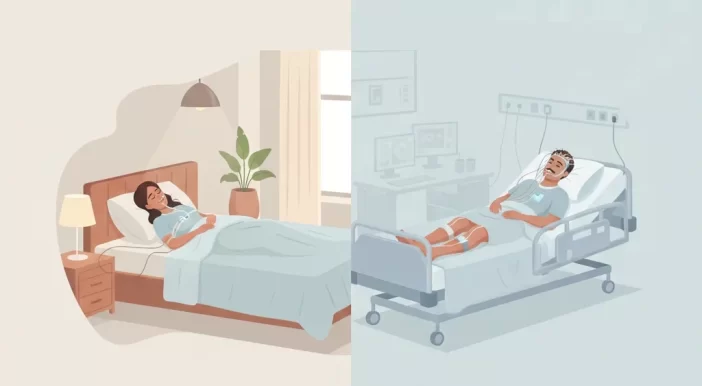
A home sleep study is done in your own bed. It is convenient, closer to natural sleep without the “First Night Effect” (the difficulty of sleeping in a new place) often felt in hospitals.
A lab sleep study is conducted in a controlled hospital setting with continuous monitoring. It is preferred when symptoms are complex, where brain waves and movements need second-by-second supervision.
In simple terms:
- Home studies suit clear, straightforward cases (90% of patients).
- Lab studies suit complex or unclear cases
Home and Hospital Sleep Study Comparison: At a Glance
| Aspect | Home Sleep Study | Lab Sleep Study |
|---|---|---|
| Environment | Natural & familiar; your own bed. | Controlled clinical setting; hospital room. |
| Technical Setup | Self-applied or Technician-assisted at home. | Technician applies sensors in the lab. |
| Signal Fixes | None (If a wire moves, it stays off). | Real-time: Technician fixes sensors immediately. |
| Comfort | High; minimal disruption to your routine. | Lower; “First Night Effect” in a new place. |
| Cost | Significantly more affordable. | Higher (includes hospital stay & staffing). |
| Best Suited For | Standard Sleep Apnea (OSA) cases. | Complex heart/lung issues or mixed symptoms. |
Sleep Study Evaluation in Navi Mumbai: The ENT Advantage
A sleep study tells us what is happening while you sleep, but an ENT evaluation tells us why.
A level 2 sleep study in Navi Mumbai, records your breathing pauses and oxygen drops.
Dr. Archana Jhawar, ENT specialist in Mumbai with 25 years of experience in sleep apnea, performs an assessment of your “upper airway anatomy” to find the specific site of the blockage.
Common “Blockage” Points Identified:
- The Nose: Deviated nasal septum or turbinate hypertrophy.
- The Throat: Enlarged tonsils or adenoids.
- The Palate: A long or thick soft palate that vibrates (causing snoring).
- The Tongue Base: Assessing if the tongue falls back during sleep.
If your sleep study shows obstructive sleep apnea or significant snoring-related airway blockage, learn more about our snoring and sleep apnea treatment options in Navi Mumbai.
Is your spouse complaining about your snoring? Record a 30-second audio clip of your sleep and bring it to your consultation. It provides vital clues to the specific site of your airway obstruction.
By combining Level 2 sleep data with a physical exam of your tonsils, septum, and palate, we create a treatment plan that actually fixes the root cause, whether it requires a CPAP machine, lifestyle changes, or a corrective surgical procedure such as septoplasty.
Home sleep study and sleep apnea evaluation are available for patients across Vashi, Navi Mumbai, and nearby areas.
Frequently Asked Questions About Sleep Study
Q. What is the difference between a Level 2 and Level 3 home sleep study?
Doctor’s Reply:
A Level 3 study mainly records breathing and oxygen levels. A Level 2 sleep study is much more comprehensive because it includes EEG (brain activity) monitoring to assess sleep stages and sleep quality.
This provides more detailed sleep analysis and and hospital grade accuracy while allowing patients to sleep naturally in their own home environment.
Q. Can a sleep study tell me why I am snoring?
Doctor’s Reply:
A sleep study confirms if you have sleep apnea and shows how low your O2 levels drop during sleep.
An ENT examination helps identify the blockage involving the nose, tonsils, palate, or throat contributing to snoring or airway narrowing.
Q. Is a home sleep study as accurate as a hospital lab study?
Doctor’s Reply:
For many patients with suspected obstructive sleep apnea, a supervised Level 2 home sleep study provides highly reliable diagnostic information.
It has the added benefit of recording your sleep in a natural sleep environment, which often provides a more realistic representation of your typical breathing patterns.
Q. Can I do a sleep study at home in Navi Mumbai?
Doctor’s Reply:
Yes. Supervised home sleep study services are available in Navi Mumbai for suitable patients who prefer testing in their own sleep environment instead of an overnight hospital stay.
Q. Will I be able to sleep normally during a home sleep study?
Doctor’s Reply:
Most patients sleep more naturally at home compared to a hospital sleep lab, which is one reason home sleep studies are often preferred for suitable cases.
Q. Home Sleep Study क्या होती है और यह कैसे होती है?
Home Sleep Study एक portable device से घर पर की जाने वाली नींद की जांच है। यह device रात भर आपकी सांस, oxygen level और snoring को record करती है। अगले दिन device वापस करने पर Dr. Archana Jhawar (Along with Chest physician ) आपकी report देखकर treatment plan बनाती हैं।
To understand how snoring and fatigue may be linked to breathing issues during sleep, you can also read:
Snoring, gasping, daytime fatigue – allergy or sleep apnea?
Don’t ignore the red flags of sleep apnea. Schedule an ENT consultation at our Navi Mumbai clinic to determine if a Level 2 home study or a lab evaluation is right for you.
About Me

Hi, I’m Dr. Archana Jhawar, an ENT & Vertigo specialist with 25 years of experience. I specialize in tinnitus, vertigo, ear, nose and throat care, and ENT surgeries. I practice at Neoalta Clinic, Vashi, and Kokilaben Dhirubhai Ambani Hospital in Navi Mumbai.
I have advanced training in vertigo management and REBT(CBT), combining evidence-based care with a compassionate approach. Beyond medicine, I enjoy reading, writing, music, yoga, and photography.
Categories
Recent Posts
Why Vertigo Happens Even When Your Brain MRI Is Normal
Sinus Headache vs Migraine: How to Tell the Difference
Home Sleep Study vs Lab Sleep Study: Which One Do You Really Need?
Snoring, Gasping, or Fatigue: Is it Nasal Allergy or Sleep Apnea?
Nasal Allergy and Sleep Problems: Why You Feel Tired All Day