
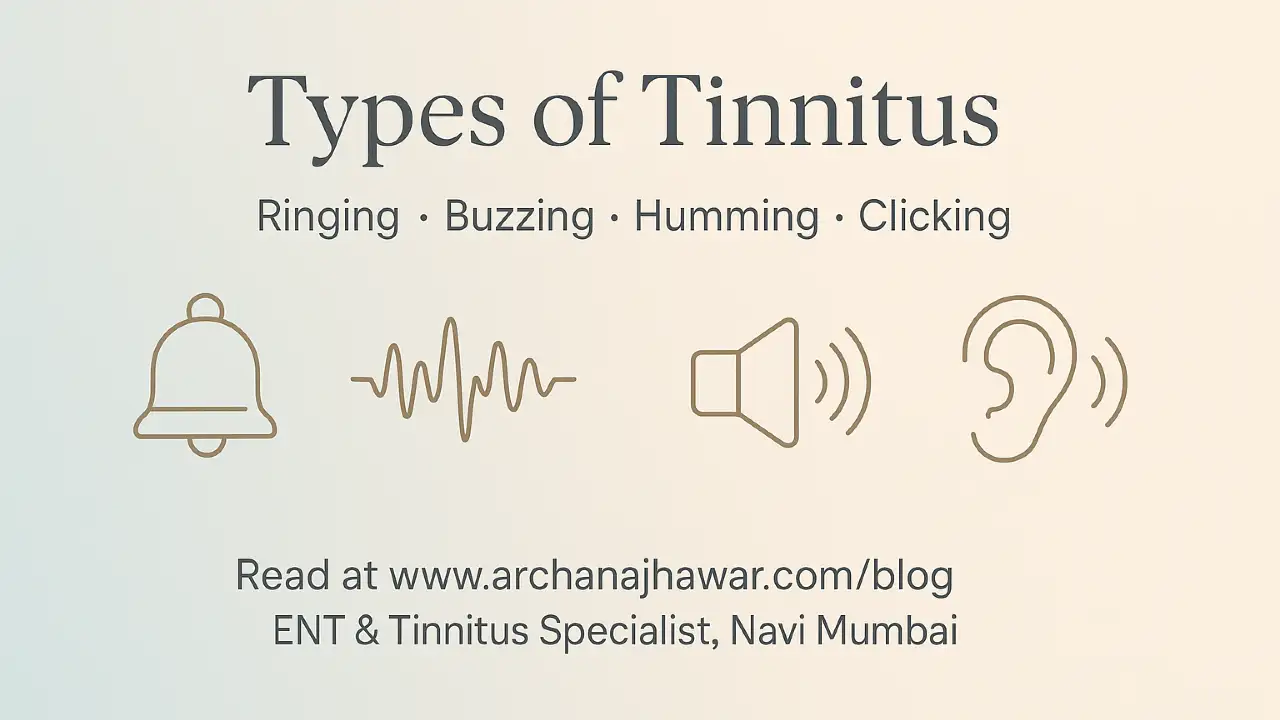
Understanding Types of Tinnitus
Have you ever heard a sound that no one else can? A ringing, buzzing, hissing or a pulsatile sound in your ears. Some feel it only at night. Others carry it like background noise all day long.
Tinnitus is more common than people realize. If you’ve been trying to make sense of your tinnitus, it helps to know that there are different types of tinnitus.
As a senior ENT specialist serving Navi Mumbai, Vashi, and Koparkhairne for over 25 years, I’ve seen how naming what you hear gives clarity.
This article focuses on the different types of tinnitus and what they may indicate.
The Two Broad Types of Tinnitus
1. Subjective Tinnitus (The Most Common One)
This is the most common type of tinnitus. You hear the sound – but no one else can. It’s created by your own brain or auditory system.
Often caused by:
- Age-related hearing loss
- Noise exposure (headphones, loud music, factory noise)
- Earwax buildup
- Stress or anxiety
- Certain medications
2. Objective Tinnitus (Rare)
This type of tinnitus can actually be heard by your doctor using a stethoscope placed near your ear or head.
It’s often due to:
- Vascular issues (blood vessel abnormalities)
- Muscle spasms in the middle ear
- Rare tumors like glomus tumors
This needs a full ENT evaluation and may require imaging tests
Subtypes You Should Know
Tonal vs. Pulsatile Tinnitus
- Tonal tinnitus: Continuous or intermittent ringing, humming, or hissing.
- Pulsatile tinnitus: matches your heartbeat. Often vascular.
If your tinnitus is rhythmic or heartbeat-like, don’t ignore it. It could be a sign of some vascular issues.
Temporary vs. Chronic Tinnitus
- Temporary: Triggered by loud music, travel, stress, or infection.
- Chronic: Lasts longer than 3–6 months. An ENT evaluation is recommended to identify possible causes and discuss treatment options.
Somatic Tinnitus
Worsens with jaw movement, neck tension, or postural issues. Common in TMJ or cervical spine problems.
This type may improve when the underlying jaw or neck problem is treated.

Types of Sounds You May Hear in Tinnitus
The type of sound you can hear in tinnitus
Ringing the ear : High-pitched, like a tuning fork
Buzzing sound in the ear: Like electricity or insects
Hissing sound in the ear: Like a TV on low volume
Whooshing / Pulsatile sound: Resembles a heartbeat or ocean wave
Clicking sound in the ear: May indicate middle ear muscle spasms or Eustachian tube issues
What If Your Reports Are Normal, But You Still Hear the Sound?
Can I Have Tinnitus Even If All My Tests Are Normal?
Yes, Tinnitus often originates in the brain’s auditory processing pathways, not just the ears. This is called neuro-auditory tinnitus. It’s a phantom sound.
It doesn’t show up in scans or hearing tests, but it is very real and very manageable. Learn why this happens in my blog on the causes of tinnitus.
Tinnitus Relief Is Possible.
If your tinnitus has been dismissed as “nothing serious,” or “you have to live with it”– know this:
There is help for tinnitus relief.
While there is no single cure, many paths offer relief from bothersome tinnitus:
- TRT (Tinnitus Retraining Therapy) to calm your sound perception
- REBT/ CBT (Cognitive behaviour Therapy or Rational Emotive Behaviour Therapy)to break the loop of anxiety and sound
- Sound therapy tools like white noise, pink noise, ear-level maskers, or meditation
- Music Therapy.
Once your ENT understands what type of tinnitus you have and whether there is an underlying cause, the most appropriate treatment can be planned. Read my complete guide on tinnitus causes, symptoms, and treatment options.
Know more about Tinnitus relief techniques.