
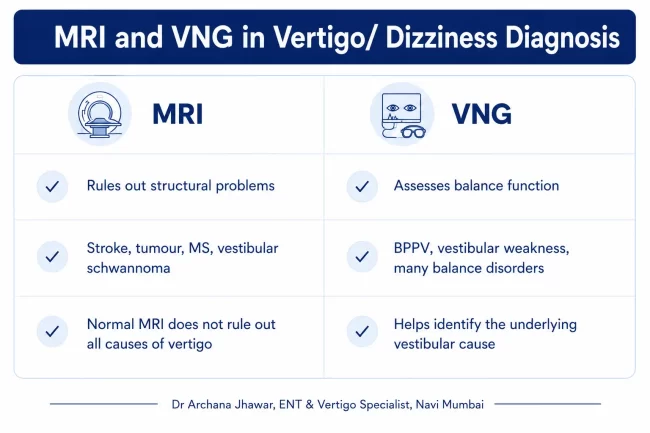
A normal brain MRI rules out major structural brain problems such as a stroke, brain tumour, or bleeding, but it cannot detect many functional disorders of the vestibular (balance) system.
Most common causes of persistent dizziness and vertigo are functional or mechanical meaning it affects how the inner ear and brain process balance signals rather than causing obvious structural changes.
As a result, conditions such as BPPV, vestibular neuritis, Ménière’s disease, PPPD, and vestibular migraine often do not appear on a routine MRI for vertigo.
As an ENT and vertigo specialist in Navi Mumbai, I regularly see patients whose scans are completely normal but whose dizziness has a clear, treatable cause.
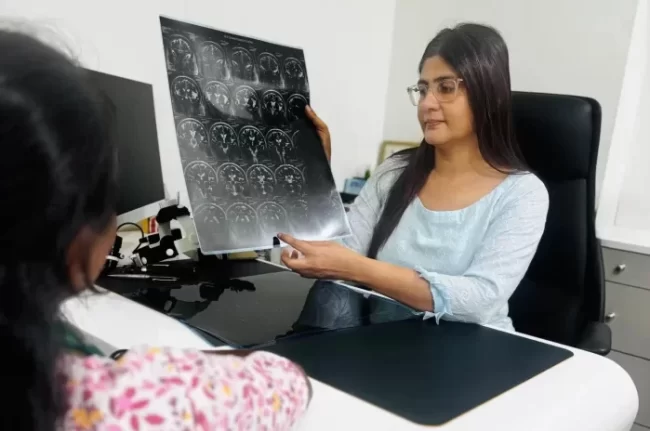
A normal MRI can be reassuring because it helps rule out serious structural conditions, such as:
However, a routine MRI cannot track function, movement, or chemistry. and does not explain why you are still experiencing dizziness, imbalance, or vertigo.
It cannot detect:
BPPV is one of the most common reasons for vertigo despite a normal MRI.
It occurs when tiny calcium crystals in the inner ear become displaced and trigger brief spinning sensations with head movements.
Turning in bed, looking upward, or bending down are common triggers.
Read more:
Vestibular migraine can cause episodes of dizziness, imbalance, or motion sensitivity even when MRI findings are normal.
Many patients experience dizziness without a significant headache. Busy visual environments, screen exposure, or travel may worsen symptoms.
Read more: Vestibular Migraine Symptoms and Treatment.
Vestibular neuritis occurs when the balance nerve becomes inflamed, often after a viral infection. Symptoms typically begin suddenly, severe spinning, nausea, and difficulty walking.
MRI scans are frequently normal because the problem affects the vestibular nerve, not brain structure.
Read more: Vestibular Neuritis symptoms and Treatment
PPPD often causes a persistent sensation of rocking, swaying, or imbalance despite normal scans and routine investigations.
Symptoms typically continue long after the original vertigo episode has settled and may worsen in busy visual environments or crowded places.
Read more: PPPD Symptoms, Diagnosis and Treatment.
Persistent or recurrent dizziness or vertigo symptoms deserve proper evaluation by an ENT & vertigo specialist or oto-neurologist, especially when routine investigations are normal.
Consider seeking a detailed vertigo assessment if:
A detailed clinical history, clinical vestibular assesment, and targeted balance tests often identify the cause of dizziness or vertigo when a routine MRI is normal.
To identify the underlying cause, the focus often needs to shift from brain imaging to evaluating the balance system itself.
Videonystagmography (VNG) is a specialized balance test that helps assess how well the inner ear and balance pathways are functioning.
At Neoalta Clinic, Vashi, VNG results are reviewed directly by an ENT specialist together with the audiologist to ensure an accurate diagnosis.
Once the cause has been identified, the next step is choosing the right treatment for your specific balance disorder.
Many patients with vertigo receive the same medication regardless of the underlying cause.
While these medicines may temporarily reduce symptoms, lasting improvement often depends on identifying the correct diagnosis first.
Different causes of vertigo require different treatments:
The most important step is not simply controlling dizziness for a few hours. It is understanding why the dizziness is occurring in the first place.
Once the cause is identified, treatment can be tailored much more effectively at our Vertigo Clinic in Navi Mumbai.

Hi, I’m Dr. Archana Jhawar, an ENT & Vertigo specialist with 25 years of experience. I specialize in tinnitus, vertigo, ear, nose and throat care, and ENT surgeries. I practice at Neoalta Clinic, Vashi, and Kokilaben Dhirubhai Ambani Hospital in Navi Mumbai.
I have advanced training in vertigo management and REBT(CBT), combining evidence-based care with a compassionate approach. Beyond medicine, I enjoy reading, writing, music, yoga, and photography.
Why Vertigo Happens Even When Your Brain MRI Is Normal
Sinus Headache vs Migraine: How to Tell the Difference
Home Sleep Study vs Lab Sleep Study: Which One Do You Really Need?
Snoring, Gasping, or Fatigue: Is it Nasal Allergy or Sleep Apnea?
Nasal Allergy and Sleep Problems: Why You Feel Tired All Day